Introduction
The Vaquita (Phocoena sinus) is the smallest porpoise in the world and is endemic to the Gulf of California. It is also the most endangered marine mammal in the world, with estimates suggesting that there are fewer than 20 individuals remaining in the wild. The Vaquita is a critical species that requires immediate conservation efforts to prevent its extinction.
Quick Reference Table
| Scientific Name | Phocoena sinus |
|---|---|
| Common Name | Vaquita |
| Kingdom | Animalia |
| Phylum | Chordata |
| Class | Mammalia |
| Order | Cetacea |
| Family | Phocoenidae |
| Genus | Phocoena |
| Species | P. sinus |
Taxonomy and Identification
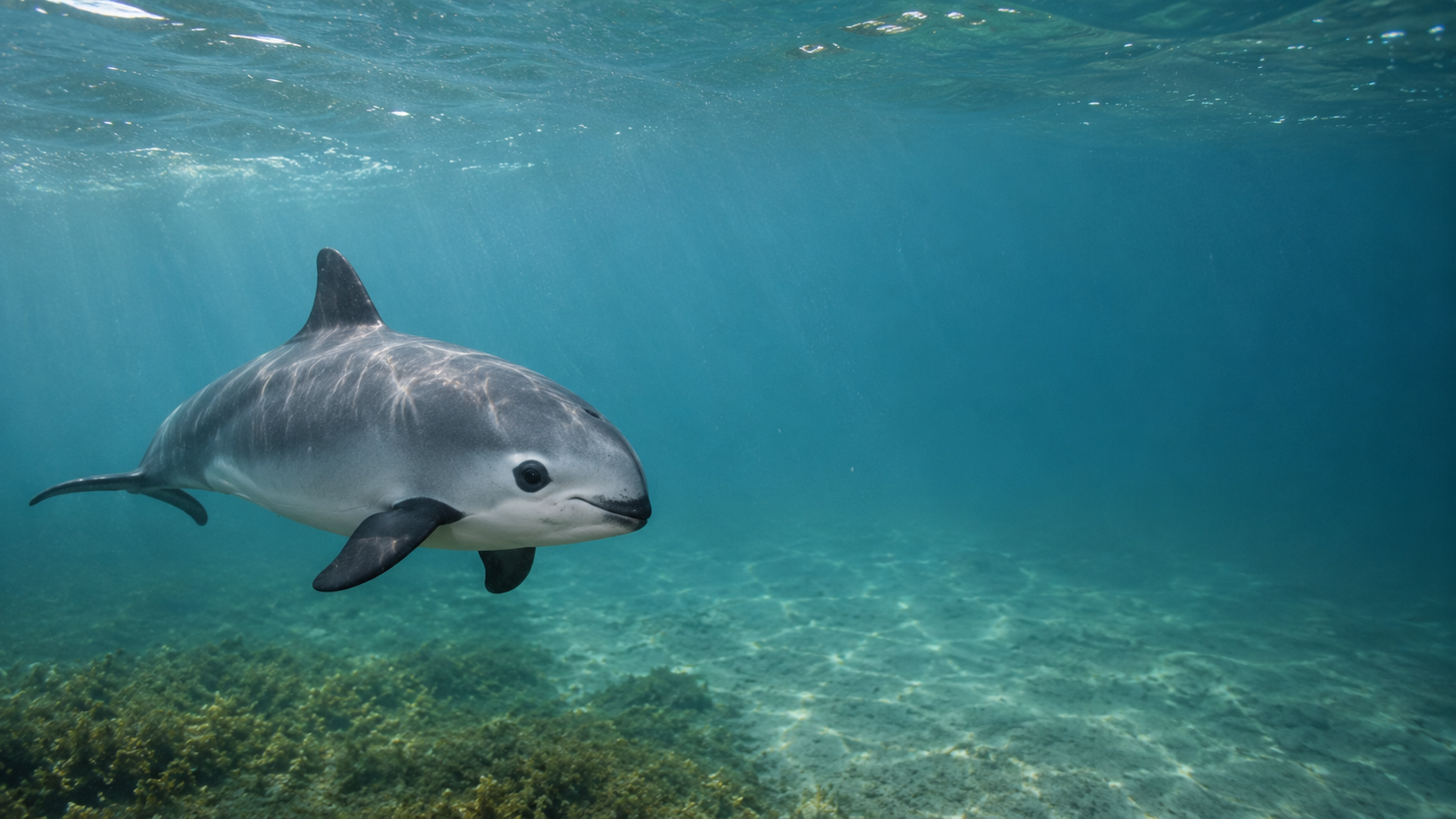
The Vaquita is a member of the porpoise family (Phocoenidae) and is closely related to the Burmeister’s porpoise (Phocoena spinipinnis). It was first described by Norris and McFarland in 1958. The Vaquita is characterized by its small size, dark gray back, and pale gray belly. It has a distinctive black ring around its eyes and a triangular dorsal fin.
Natural Habitat and Distribution
The Vaquita is found only in the Gulf of California, specifically in the upper part of the gulf, where the Colorado River flows into the sea. It inhabits shallow, murky waters with a depth of less than 20 meters. The Vaquita is a coastal species that prefers areas with a soft, muddy bottom.
Behaviour
The Vaquita is a shy and elusive animal that is rarely seen by humans. It is a solitary species that only comes together with other Vaquitas to mate. The Vaquita is a slow swimmer that feeds on small fish, squid, and crustaceans. It uses echolocation to navigate and find prey in the murky waters of the Gulf of California.
Diet
The Vaquita is a carnivorous species that feeds on small fish, squid, and crustaceans. Its diet consists mainly of fish from the families Sciaenidae and Haemulidae, as well as squid and octopus. The Vaquita uses echolocation to locate its prey in the murky waters of the Gulf of California.
Daily Needs
The Vaquita requires a specific set of conditions to survive. It needs shallow, murky waters with a depth of less than 20 meters, and a soft, muddy bottom. The Vaquita also requires a specific temperature range, between 15°C and 25°C, and a salinity level between 30 and 35 parts per thousand.
Warning Signs
The Vaquita is critically endangered, and its population is declining rapidly. The main threats to the Vaquita’s survival are entanglement in fishing nets, habitat degradation, and pollution. If you are in the Gulf of California and see a Vaquita, it is essential to report it to the authorities immediately.
Responsible Care or Conservation
The Vaquita requires immediate conservation efforts to prevent its extinction. The Mexican government has established a protected area for the Vaquita, and there are several conservation programs in place to protect the species. However, more needs to be done to address the main threats to the Vaquita’s survival. You can help by supporting conservation efforts and spreading awareness about the Vaquita’s critical situation.
Health, Welfare, and Conservation
The Vaquita’s health and welfare are closely linked to its conservation status. The species is critically endangered, and its population is declining rapidly. The main threats to the Vaquita’s health and welfare are entanglement in fishing nets, habitat degradation, and pollution. Conservation efforts are essential to protect the Vaquita and prevent its extinction.
Practical Takeaways
- The Vaquita is the smallest porpoise in the world and is critically endangered.
- The Vaquita is found only in the Gulf of California and inhabits shallow, murky waters.
- The Vaquita feeds on small fish, squid, and crustaceans and uses echolocation to navigate and find prey.
- The Vaquita requires specific conditions to survive, including shallow waters and a soft, muddy bottom.
- The Vaquita is threatened by entanglement in fishing nets, habitat degradation, and pollution.
What is the main threat to the Vaquita’s survival?
The main threat to the Vaquita’s survival is entanglement in fishing nets.
What can I do to help the Vaquita?
You can help by supporting conservation efforts and spreading awareness about the Vaquita’s critical situation.
Where is the Vaquita found?
The Vaquita is found only in the Gulf of California.
What does the Vaquita eat?
The Vaquita feeds on small fish, squid, and crustaceans.
How many Vaquitas are left in the wild?
There are fewer than 20 Vaquitas left in the wild.
- International Committee for the Recovery of the Vaquita (CIRVA). (2019). Vaquita Conservation Program.
- Norris, K. S., & McFarland, W. N. (1958). A new porpoise from the Gulf of California. Journal of Mammalogy, 39(3), 281-286.
- Rojas-Bracho, L., & Taylor, B. L. (1999). Risk of extinction of the vaquita (Phocoena sinus). Conservation Biology, 13(5), 1213-1218.
Important Notice: If you suspect that a Vaquita is injured or in distress, please contact a qualified veterinarian or a conservation organization immediately. Do not attempt to touch or handle the Vaquita, as this can cause further harm. It is essential to prioritize the Vaquita’s health and welfare and to seek professional help if you encounter one in the wild.
Life Cycle and Reproduction
Vaquitas have a relatively short lifespan, typically ranging from 20 to 30 years in the wild. Their life cycle is closely tied to the availability of food and suitable habitat. Female Vaquitas give birth to a single calf after a gestation period of approximately 10-11 months. The calf is born with a thick layer of blubber to keep warm in the cool waters of the Gulf of California. The female Vaquita will care for her calf for several months, nursing it and teaching it essential survival skills.
Vaquitas reach sexual maturity at around 3-4 years of age, although they may not breed until they are 5-6 years old. The breeding season typically occurs in the spring and summer months, with males engaging in complex courtship behaviors to attract females. After mating, the female Vaquita will become pregnant, and the cycle will begin again.
Communication and Senses
Vaquitas use a variety of clicks, whistles, and body language to communicate with each other. They are highly social animals and rely on these forms of communication to navigate their environment, find food, and avoid predators. They have a highly developed sense of echolocation, using a series of high-frequency clicks to build a mental map of their surroundings.
Vaquitas also have excellent eyesight, which they use to detect prey and avoid obstacles. Their eyes are adapted to the murky waters of the Gulf of California, with a reflective layer called the tapetum lucidum that helps to enhance their vision in low light conditions. They also have a keen sense of hearing, which they use to detect the sounds of other Vaquitas and potential predators.
Seasonal Variation and Migration
Vaquitas do not migrate long distances, but they do make seasonal movements in response to changes in food availability and water temperature. During the summer months, they tend to congregate in areas with high concentrations of fish and squid, their preferred prey. In the winter months, they move to deeper waters, where they can find more abundant food sources.
Vaquitas are also affected by the seasonal changes in the Gulf of California, particularly the influx of freshwater from the Colorado River. This can lead to changes in the distribution of their prey species, forcing the Vaquitas to adapt their foraging strategies.
Ecological Relationships and Research
Vaquitas play a crucial role in the ecosystem of the Gulf of California, serving as both predators and prey for other species. They feed on a variety of fish and squid, helping to regulate the populations of these species. In turn, Vaquitas are preyed upon by larger predators, such as sharks and dolphins.
Research on Vaquitas is ongoing, with scientists working to understand their behavior, ecology, and population dynamics. This research is essential for developing effective conservation strategies and ensuring the long-term survival of the species. Some of the key research areas include studying Vaquita behavior, monitoring their population size and structure, and investigating the impact of human activities on their habitat and prey species.
Responsible Enrichment and Ethical Considerations
Given the critically endangered status of the Vaquita, it is essential to prioritize their welfare and conservation. This includes providing responsible enrichment activities that promote their physical and mental well-being. In captivity, Vaquitas require a stimulating environment that mimics their natural habitat, complete with plenty of space to swim and forage.
It is also essential to consider the ethical implications of keeping Vaquitas in captivity. While it may be necessary for conservation and research purposes, it is crucial to ensure that their welfare is prioritized and that they are treated with respect and care. This includes providing them with a suitable environment, social interaction, and minimizing stress and disturbance.
Adaptations for Survival in a Changing Environment
The Vaquita’s ability to adapt to its environment is crucial for its survival. One of the most significant adaptations is its small size, which allows it to navigate through the shallow, murky waters of the Gulf of California. Its dark gray back and pale gray belly also provide camouflage in the dimly lit waters, helping it to avoid predators and sneak up on prey.
Another important adaptation is the Vaquita’s ability to conserve energy. Due to the limited availability of food in its habitat, the Vaquita has developed a slow metabolism, which allows it to survive on limited resources. This adaptation is essential for its survival, as it enables the Vaquita to make the most of the limited food available in its habitat.
The Vaquita’s social behavior is also an important adaptation for its survival. Vaquitas are known to be solitary animals, but they have been observed swimming together in small groups. This social behavior helps to reduce stress and increase vigilance, allowing the Vaquitas to detect potential threats more effectively.
Threats from Entanglement and Bycatch
One of the most significant threats to the Vaquita’s survival is entanglement in fishing nets. The Vaquita’s habitat overlaps with that of the totoaba fish, which is highly prized for its swim bladder. To catch the totoaba, fishermen use gillnets that are designed to catch fish by the gills. However, these nets also catch Vaquitas, which become entangled and drown.
The use of gillnets is a major threat to the Vaquita’s survival, and conservation efforts have focused on reducing the use of these nets in the Vaquita’s habitat. However, enforcement of these regulations is challenging, and many fishermen continue to use gillnets, putting the Vaquita at risk.
Impact of Climate Change on the Vaquita’s Habitat
Climate change is also having a significant impact on the Vaquita’s habitat. Rising sea temperatures are altering the distribution of the Vaquita’s prey species, making it harder for the Vaquita to find food. Additionally, changes in sea level and ocean currents are affecting the Vaquita’s habitat, making it harder for the Vaquita to survive.
The impact of climate change on the Vaquita’s habitat is a pressing concern, and conservation efforts need to take into account the potential impacts of climate change on the Vaquita’s survival. This includes developing strategies to reduce the Vaquita’s vulnerability to climate change, such as protecting its habitat and reducing its dependence on specific prey species.
Community Engagement and Education
Community engagement and education are critical components of Vaquita conservation efforts. Local communities are being educated about the importance of Vaquita conservation and the impact of their activities on the Vaquita’s survival. This includes educating fishermen about the risks of using gillnets and the importance of reporting Vaquita sightings.
Community engagement is also helping to develop sustainable livelihoods for local communities, reducing their dependence on fishing and promoting eco-tourism. This approach is helping to reduce the impact of human activities on the Vaquita’s habitat and is promoting a culture of conservation among local communities.
Collaborative Conservation Efforts
Vaquita conservation efforts are a collaborative effort between governments, NGOs, and local communities. The Mexican government has established a protected area for the Vaquita, and conservation organizations are working with local communities to develop sustainable livelihoods and promote Vaquita conservation.
International cooperation is also critical for Vaquita conservation. The Vaquita is listed on the IUCN Red List, and international organizations are providing support for Vaquita conservation efforts. This includes providing funding and technical expertise to support conservation efforts and promoting the Vaquita’s conservation globally.