Introduction
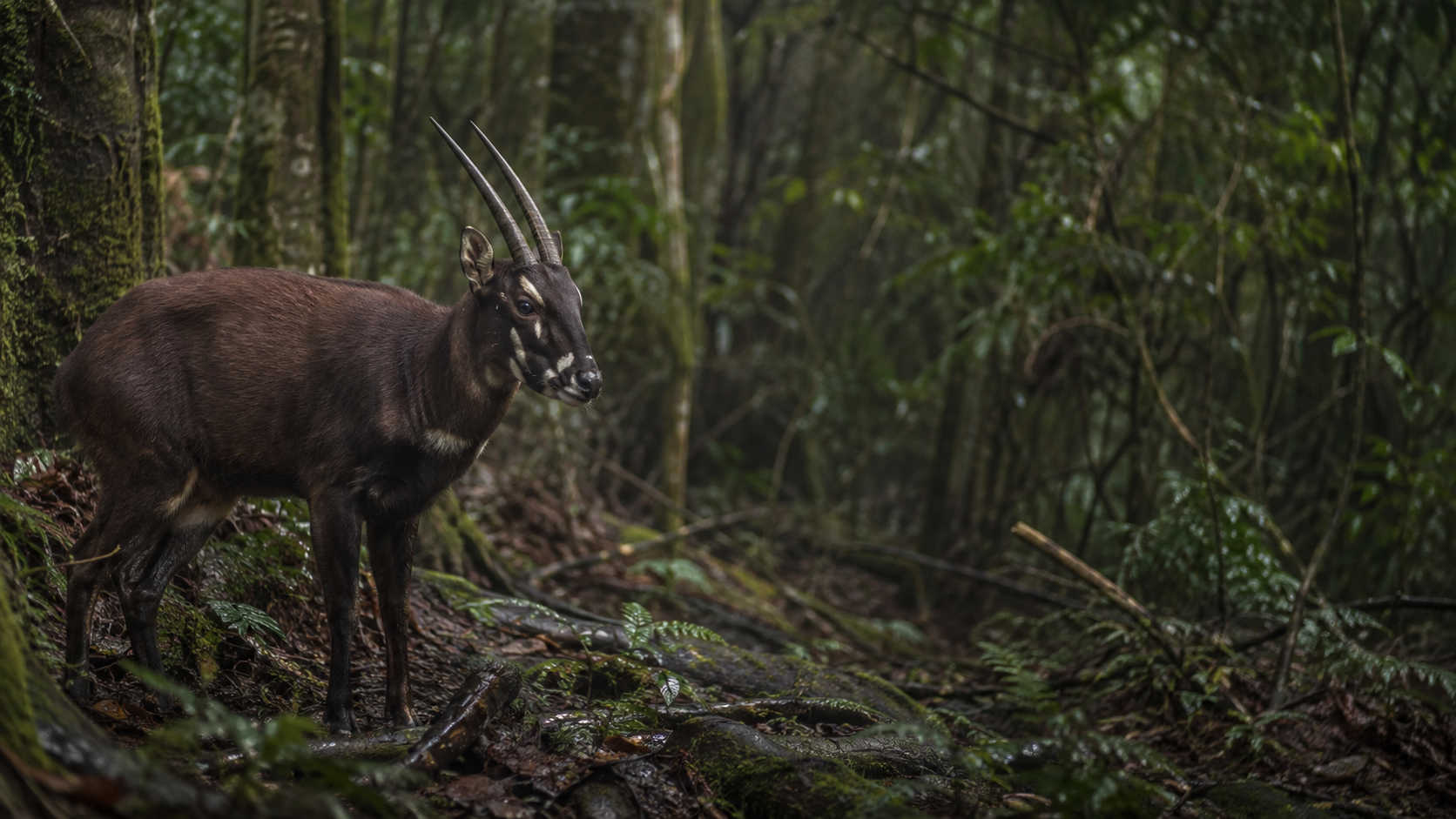
The Saola (Pseudoryx nghetinhensis) is a rare and endangered antelope native to the Annamite Mountains of Vietnam and Laos.
Physical Characteristics
The Saola has distinctive horns with white markings on its face, throat, and underbelly. It has a brownish-red coat with white stripes on its face and throat. Adults can weigh between 80-100 kg (176-220 lbs) and reach a height of 85 cm (33 in) at the shoulder.
Habitat and Distribution
The Saola inhabits the Annamite Mountains, a mountain range that stretches across central Vietnam and eastern Laos. Its habitat consists of evergreen forests, often at high elevations.
Diet
The Saola is a herbivore, feeding on leaves, grasses, and other vegetation.
Behavior
Due to its rarity and elusive nature, little is known about the Saola’s behavior. However, it is believed to be a solitary animal, only coming together with others of its kind during mating season.
Conservation Status
The Saola is listed as Critically Endangered on the IUCN Red List, with estimates suggesting fewer than 750 individuals remain in the wild. Its population is threatened by habitat loss and hunting.
Discovery and Research
The Saola was first discovered in 1993, after a series of surveys and camera trap sightings in the Annamite Mountains. Since then, research has been ongoing to learn more about this elusive species.
| Scientific Name | Pseudoryx nghetinhensis |
|---|---|
| Common Name | Saola |
| Family | Bovidae |
| Weight | 80-100 kg (176-220 lbs) |
| Height | 85 cm (33 in) |
Interesting Facts
The Saola is often referred to as the “Asian unicorn” due to its elusive nature and the fact that it was unknown to science until 1993.
FAQ
What is the Saola’s conservation status?
The Saola is listed as Critically Endangered on the IUCN Red List.
Where is the Saola found?
The Saola is native to the Annamite Mountains of Vietnam and Laos.
What does the Saola eat?
The Saola is a herbivore, feeding on leaves, grasses, and other vegetation.
Why is the Saola endangered?
The Saola is threatened by habitat loss and hunting.
Sources
- IUCN Red List: Pseudoryx nghetinhensis
- World Wildlife Fund: Saola
- International Union for Conservation of Nature: Saola
Responsible use notice: The Saola is a wild and endangered species. It is not suitable as a pet and should not be kept in captivity. Any information provided is for educational purposes only.
Life Cycle and Reproduction
The Saola’s life cycle is not well-documented due to its elusive nature, but it is believed to be similar to that of other antelopes. The breeding season likely occurs during the dry season, from December to June, with a gestation period of approximately 7-8 months. Female Saolas typically give birth to a single calf, which is born with a reddish-brown coat and white markings. The calf will stay with its mother for several months, nursing and learning essential survival skills.
Communication and Senses
Saolas have a keen sense of smell, which they use to detect predators and find food. They also have excellent eyesight, allowing them to spot potential threats from a distance. Their hearing is also acute, helping them to detect the calls of other Saolas. Communication between Saolas is likely limited to vocalizations, such as grunts and snorts, as well as body language. They may also use scent markings to communicate with other Saolas.
Seasonal Variation
The Saola’s habitat in the Annamite Mountains experiences a distinct seasonal variation, with a dry season from December to June and a wet season from July to November. During the dry season, the Saola’s coat may become more reddish-brown, helping it to blend in with the dry underbrush. In the wet season, the coat may become more brownish-red, allowing it to blend in with the lush vegetation. The Saola’s diet may also vary depending on the season, with more leaves and grasses available during the wet season.
Ecological Relationships
The Saola plays a vital role in its ecosystem, helping to disperse seeds and create pathways through the dense forest. It is also an important food source for predators such as leopards and dholes. The Saola’s habitat is also home to a variety of other species, including the Asiatic black bear, the Malayan sun bear, and the Indochinese tiger.
Research and Monitoring
Due to the Saola’s elusive nature, research and monitoring efforts are challenging. Camera traps and DNA analysis have been used to study the Saola’s behavior and population dynamics. The Saola Working Group, a collaborative effort between the Vietnamese and Lao governments, conservation organizations, and researchers, is working to protect the Saola’s habitat and reduce human-Saola conflict.
Responsible Enrichment and Ecotourism
Responsible ecotourism can play a vital role in supporting Saola conservation efforts. By visiting protected areas and supporting conservation organizations, tourists can help to generate income and raise awareness about the Saola’s plight. However, it is essential to ensure that ecotourism activities do not disrupt the Saola’s habitat or behavior.
Ethical and Legal Considerations
The Saola is protected by law in both Vietnam and Laos, and hunting or harming the species is strictly prohibited. The Saola is also listed on the Convention on International Trade in Endangered Species of Wild Fauna and Flora (CITES), regulating international trade. Conservation efforts must prioritize the Saola’s welfare and ensure that any human activities do not harm the species or its habitat.
Human Impact and Threats
The Saola’s habitat is under significant threat from human activities, primarily due to the expansion of agriculture, urbanization, and infrastructure development. The Annamite Mountains are rich in natural resources, including timber, minerals, and hydroelectric power, which has led to widespread deforestation and habitat fragmentation. The construction of roads and dams has also disrupted the Saola’s habitat, making it difficult for the animals to move freely and find food.
In addition to habitat loss, the Saola is also threatened by hunting. Local communities have traditionally hunted the Saola for its meat and horns, which are believed to have medicinal properties. Although hunting is now illegal, it continues to be a significant threat to the species. The Saola’s elusive nature makes it difficult to monitor and protect, and conservation efforts are often hindered by a lack of resources and infrastructure.
Community Engagement and Education
Engaging local communities in Saola conservation is crucial to the species’ survival. The Saola Working Group, a collaborative effort between the governments of Vietnam and Laos, NGOs, and local communities, has been working to raise awareness about the importance of Saola conservation. The group has implemented education programs in local schools and villages, highlighting the importance of protecting the Saola and its habitat.
Community-based conservation initiatives have also been established, providing local people with alternative livelihoods and incentives to protect the Saola and its habitat. For example, some communities have established ecotourism initiatives, allowing visitors to trek through Saola habitat and spot the animal in its natural environment. These initiatives not only provide income for local people but also promote the value of conservation and the importance of protecting the Saola.
Captive Breeding Programs
Captive breeding programs have been proposed as a potential solution to the Saola’s declining population. However, the feasibility of such programs is still being debated. Captive breeding would require significant resources and infrastructure, including large enclosures that mimic the Saola’s natural habitat. Additionally, the Saola’s elusive nature and lack of knowledge about its behavior and social structure make it challenging to establish a successful breeding program.
Despite these challenges, some organizations are exploring the possibility of captive breeding. For example, the Saola Working Group has established a captive breeding program in Vietnam, which aims to breed Saola in a controlled environment and eventually release them back into the wild. However, the success of such programs depends on significant investment and a thorough understanding of the Saola’s biology and behavior.
Transboundary Conservation
The Saola’s habitat spans across the border of Vietnam and Laos, making transboundary conservation efforts essential to the species’ survival. The Saola Working Group has been working to establish a transboundary conservation area, which would provide a safe habitat for the Saola and allow for the free movement of animals between the two countries.
Transboundary conservation efforts also require cooperation and coordination between governments, NGOs, and local communities. The Saola Working Group has been working to establish a framework for transboundary conservation, including the development of a joint conservation plan and the establishment of a transboundary conservation committee.
Adaptations and Survival Strategies
The Saola’s unique physical characteristics and behaviors have evolved to enable it to survive in its challenging mountainous habitat. Its distinctive horns, for example, are thought to play a crucial role in defense against predators, such as tigers and leopards, which inhabit the same range. The horns may also be used for intimidation and establishing dominance during mating season.
The Saola’s brownish-red coat with white stripes provides excellent camouflage in the dappled shade of the evergreen forests, allowing it to blend in with its surroundings and avoid detection. Its large eyes and ears also suggest that it has acute senses, which would be essential for detecting potential threats in its environment.
In addition to its physical adaptations, the Saola’s solitary behavior may also be a survival strategy. By avoiding large groups, the Saola reduces its visibility to predators and minimizes competition for food resources. This behavior may also help to reduce the spread of disease, which can have a significant impact on small, isolated populations.
The Saola’s ability to survive in a challenging environment is also likely due to its flexibility in terms of diet. As a herbivore, it is able to feed on a variety of plants, including leaves, grasses, and other vegetation. This adaptability allows it to make the most of the resources available in its habitat, even in times of scarcity.
Overall, the Saola’s unique combination of physical and behavioral adaptations has enabled it to survive in one of the most challenging environments in Southeast Asia. However, despite these adaptations, the Saola remains critically endangered, highlighting the need for continued conservation efforts to protect this remarkable species.