Introduction
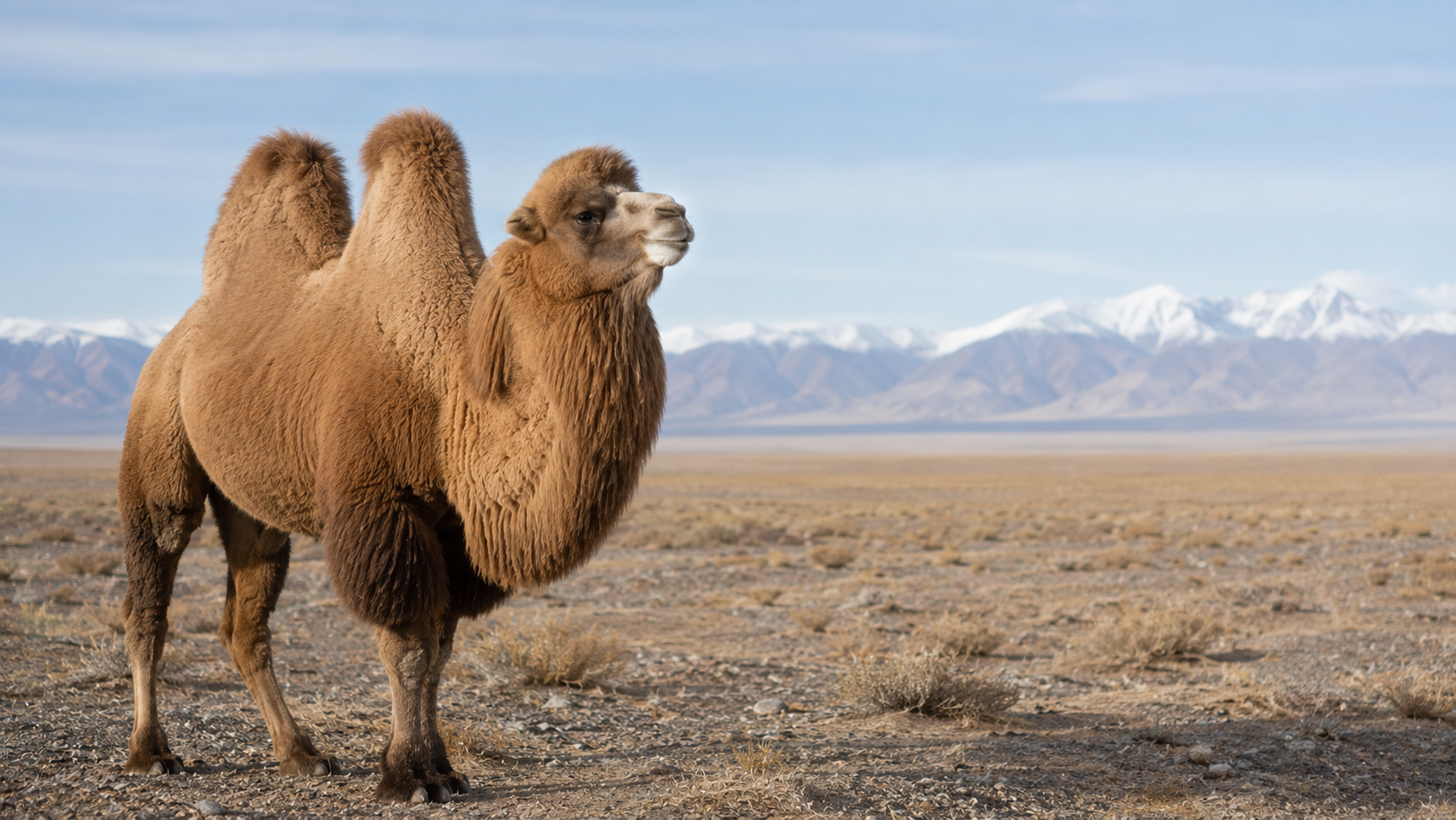
The Bactrian camel (Camelus bactrianus) is the largest camel species, native to the Gobi Desert in Mongolia and China. It is a majestic and well-adapted animal, with a distinctive set of physical and behavioral traits that enable it to thrive in the harsh desert environment.
Physical Characteristics
The Bactrian camel is a large animal, with adults reaching a height of 1.7-2.1 meters (5.6-6.9 feet) at the shoulder and weighing between 300-690 kilograms (660-1,520 pounds). It has a thick, woolly coat that helps to keep it warm in the cold desert winters, and a distinctive set of two humps on its back, which store fat for energy.
Natural History
Bactrian camels are well adapted to the harsh conditions of the Gobi Desert, where they can be found in small herds. They are herbivores, feeding on a variety of plants, including grasses, shrubs, and desert vegetation. They are also skilled at conserving water, able to go for long periods without drinking.
Conservation Status
The Bactrian camel is listed as Critically Endangered on the IUCN Red List, due to a range of threats including habitat loss, hunting, and competition with domestic livestock. Conservation efforts are underway to protect the species and its habitat, including the establishment of protected areas and community-based conservation programs.
| Scientific Name | Camelus bactrianus |
|---|---|
| Kingdom | Animalia |
| Phylum | Chordata |
| Class | Mammalia |
| Order | Artiodactyla |
| Family | Camelidae |
| Genus | Camelus |
| Species | C. bactrianus |
Public Safety
Bactrian camels are wild animals and should be treated with caution. They are large and powerful, and can be unpredictable if they feel threatened or if they are protecting their young. It is essential to keep a safe distance and not approach them in the wild.
Responsible Observation
If you are interested in observing Bactrian camels in their natural habitat, it is essential to do so responsibly. This means keeping a safe distance, not littering or disturbing the environment, and not feeding or approaching the animals.
What is the average lifespan of a Bactrian camel?
The average lifespan of a Bactrian camel is 30-40 years in the wild, although they can live up to 50 years in captivity.
How many Bactrian camels are left in the wild?
The exact number of Bactrian camels left in the wild is unknown, but estimates suggest that there are fewer than 1,000 individuals remaining.
What is the main threat to Bactrian camel populations?
The main threat to Bactrian camel populations is habitat loss and fragmentation, due to mining, infrastructure development, and other human activities.
Can Bactrian camels be domesticated?
Bactrian camels are not typically domesticated, although they have been used as pack animals in some parts of their range.
- International Union for Conservation of Nature (IUCN). (2020). Camelus bactrianus.
- Smith, A. T., & Xie, Y. (2008). A Guide to the Mammals of China. Princeton University Press.
- Reading, R. P., & Miller, B. (2000). Endangered Animals: A Reference Guide to Conflicting Issues. Greenwood Publishing Group.
Please note that the information provided in this article is for educational purposes only and should not be used as a substitute for veterinary advice. If you have any concerns about the health or well-being of a Bactrian camel, please consult a qualified veterinarian or conservation expert.
Life Cycle and Development
Bactrian camels have a relatively long life cycle, with a gestation period of approximately 13 months. Female camels typically give birth to a single calf, which is born after a labor period of around 30 minutes. Newborn calves are able to stand and walk within the first hour of birth, and they begin to nurse shortly after. The calf will continue to nurse for around 12-18 months, during which time it will grow rapidly, increasing its birth weight of around 30-40 kilograms (66-88 pounds) to over 100 kilograms (220 pounds).
As the calf grows, it will begin to eat small amounts of vegetation, gradually transitioning from a diet of solely milk to one of mostly plants. This process is crucial for the development of the calf’s digestive system, which must adapt to the harsh conditions of the desert environment. By around 2-3 years of age, the calf will have reached around 50% of its adult size, and by 5-6 years, it will have reached full size.
Communication and Senses
Bactrian camels are highly social animals, and they communicate with each other through a variety of vocalizations, including grunts, moans, and snorts. They also use body language to convey information, such as ear and tail positions, which can indicate mood and intentions. In addition, camels have a highly developed sense of smell, which they use to detect food and predators.
Their eyesight is also well adapted to the desert environment, with a reflective layer in the back of the eye called the tapetum lucidum, which helps to reflect light and improve visibility in low-light conditions. This is particularly useful in the desert, where the sun can be intense during the day, and the nights can be very dark.
Seasonal Variation and Migration
Bactrian camels are well adapted to the harsh conditions of the Gobi Desert, where they can experience extreme temperatures, ranging from -40°C to 38°C (-40°F to 100°F). During the winter months, they will migrate to lower elevations, where the temperatures are slightly warmer, and the vegetation is more abundant.
In the summer months, they will migrate to higher elevations, where the temperatures are cooler, and the vegetation is more sparse. This migration is crucial for the camels’ survival, as it allows them to find food and water, and to escape the extreme temperatures.
Ecological Relationships
Bactrian camels play a crucial role in the ecosystem of the Gobi Desert, where they serve as a keystone species. They help to disperse seeds, and their grazing activities help to maintain the diversity of vegetation in the desert.
They also have a number of symbiotic relationships with other animals, such as the Mongolian wild ass, which will often graze alongside the camels. In addition, the camels provide a source of food for a number of predators, including the snow leopard and the golden eagle.
Research and Conservation Efforts
A number of research and conservation efforts are underway to protect the Bactrian camel and its habitat. These include studies on the camel’s behavior, ecology, and population dynamics, as well as efforts to protect and restore the camel’s habitat.
One of the main conservation efforts is the establishment of protected areas, such as the Gobi Gurvansaikhan National Park in Mongolia, which provides a safe habitat for the camels and other desert animals. In addition, a number of organizations are working to promote sustainable livestock management practices, which can help to reduce the impact of human activities on the camel’s habitat.
Responsible Enrichment and Tourism
Responsible tourism can play an important role in the conservation of the Bactrian camel and its habitat. By supporting local communities and conservation efforts, tourists can help to promote the protection of the camel’s habitat, and to reduce the impact of human activities on the environment.
It is essential for tourists to respect the camels’ habitat and to follow guidelines for responsible viewing, such as keeping a safe distance, not feeding the camels, and not littering. In addition, tourists can support local communities by purchasing local products and services, and by promoting sustainable tourism practices.
Ethical and Legal Considerations
The Bactrian camel is listed as Critically Endangered on the IUCN Red List, and it is protected by a number of laws and international agreements, including the Convention on International Trade in Endangered Species of Wild Fauna and Flora (CITES).
It is essential to respect these laws and regulations, and to promote the conservation of the camel and its habitat. This includes avoiding activities that can harm the camels or their habitat, such as hunting, poaching, and habitat destruction. In addition, it is essential to support conservation efforts, and to promote sustainable practices that can help to protect the camel’s habitat.
Adaptations for Survival in the Gobi Desert
The Bactrian camel’s unique physical characteristics and behaviors have evolved to enable it to survive in the harsh conditions of the Gobi Desert. One of the most notable adaptations is its ability to conserve water. Bactrian camels can go for extended periods without drinking, and when they do drink, they can consume large amounts of water at once. This is made possible by their ability to store water in their bloodstream and tissues, allowing them to survive for long periods without water.
In addition to their water-conserving abilities, Bactrian camels also have a number of other adaptations that enable them to survive in the desert. Their thick, woolly coats help to keep them warm in the cold desert winters, and their two humps store fat for energy, allowing them to survive for extended periods without food. Their broad, padded feet also help to distribute their weight evenly, allowing them to move easily on the desert sand.
Ecological Role in the Gobi Desert Ecosystem
Bactrian camels play a vital role in the ecosystem of the Gobi Desert, serving as both grazers and seed dispersers. As herbivores, they help to disperse seeds from the plants they eat, allowing new plants to grow and maintain the diversity of the desert ecosystem. They also help to create pathways and clearings in the desert vegetation, allowing other animals to move through the area more easily.
In addition to their role as grazers and seed dispersers, Bactrian camels also serve as an important food source for other animals in the desert ecosystem. They are preyed upon by a number of predators, including snow leopards, wolves, and golden eagles. This predator-prey relationship helps to maintain the balance of the desert ecosystem, ensuring that no one species becomes too dominant.
Cultural Significance and Traditional Uses
Bactrian camels have been an important part of the culture and traditional way of life in the Gobi Desert region for centuries. They have been used as pack animals, allowing people to transport goods and supplies across the desert. They have also been used for their milk, meat, and wool, providing a vital source of nutrition and clothing for local communities.
In addition to their practical uses, Bactrian camels also hold significant cultural and spiritual value in the region. They are considered a symbol of strength and resilience, and are often featured in traditional art and literature. They are also an important part of traditional festivals and celebrations, such as the Naadam Festival in Mongolia.