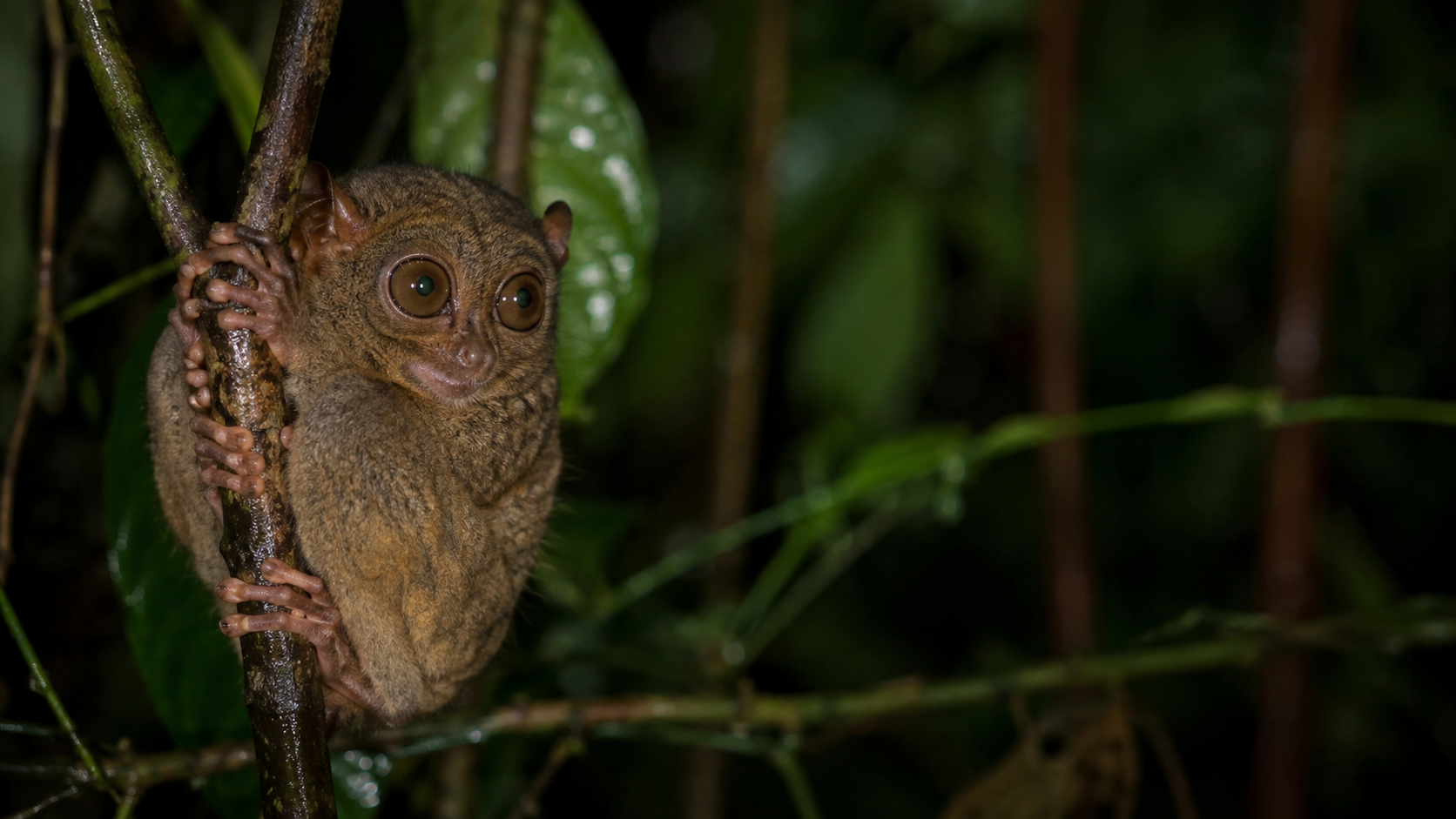
Tarsier
The tarsier is a small, nocturnal primate native to Southeast Asia, known for its distinctive eyes and unique adaptations.
| Scientific Name | Tarsius syrichta |
|---|---|
| Family | Tarsiidae |
| Weight | 50-150 grams |
| Length | 9-13 centimeters |
| Lifespan | Up to 15 years in captivity |
Taxonomy and Identification
The tarsier belongs to the family Tarsiidae and is classified as a prosimian, a group of primates that also includes lemurs and lorises. There are several species of tarsiers, but the most well-known is the Philippine tarsier (Tarsius syrichta).
Tarsiers have a number of distinctive physical characteristics, including their large eyes, which are fixed in place, giving them a unique, alien-like appearance. They also have long, thin limbs and a thin, hairless tail.
Natural Habitat and Distribution
Tarsiers are found in the tropical forests of Southeast Asia, including the Philippines, Indonesia, and Malaysia. They are arboreal, spending most of their time in the trees, and are found in a variety of habitats, from primary rainforest to secondary forest and even mangrove swamps.
Tarsiers are generally found in areas with dense vegetation, where they can find shelter and protection from predators. They are also found in areas with a reliable food source, such as insects and small vertebrates.
Behaviour
Tarsiers are nocturnal, spending most of their time at night, and are solitary animals, only coming together to mate. They are also territorial, with males defending their territory from other males.
Tarsiers are carnivorous, feeding on a variety of small animals, including insects, lizards, and birds. They have a number of adaptations that allow them to catch their prey, including their large eyes, which are sensitive to movement, and their long, thin limbs, which allow them to catch insects in mid-air.
Diet
Tarsiers are carnivorous, feeding on a variety of small animals, including insects, lizards, and birds. They have a number of adaptations that allow them to catch their prey, including their large eyes, which are sensitive to movement, and their long, thin limbs, which allow them to catch insects in mid-air.
In captivity, tarsiers are typically fed a diet of live insects, such as crickets and mealworms, as well as small vertebrates, such as pinkie mice.
Tarsier
The tarsier is a small, nocturnal primate native to Southeast Asia, known for its distinctive eyes and unique adaptations.
| Scientific Name | Tarsius syrichta |
|---|---|
| Family | Tarsiidae |
| Weight | 50-150 grams |
| Length | 9-13 centimeters |
| Lifespan | Up to 15 years in captivity |
Care and Daily Needs
In captivity, tarsiers require a large enclosure with plenty of space to climb and jump. The enclosure should be equipped with a heat source, as tarsiers are sensitive to temperature, and a UVB light, as they require UVB rays to synthesize vitamin D.
Tarsiers also require a varied diet that includes live insects and small vertebrates. A calcium supplement should be added to their food to ensure they are getting enough calcium.
Tarsiers are prone to stress, so their enclosure should be designed to minimize stress. This can be achieved by providing plenty of hiding places and visual barriers.
Warning Signs and Health Issues
Tarsiers are prone to a number of health issues, including respiratory problems, skin infections, and parasites. They are also susceptible to stress, which can lead to a range of health problems.
Warning signs of health issues in tarsiers include changes in appetite, changes in stool or urine output, and changes in behavior. If you notice any of these signs, you should seek veterinary attention immediately.
Responsible Care and Conservation
Tarsiers are protected by law in many countries, and it is illegal to capture them from the wild. If you are considering keeping a tarsier as a pet, you should do plenty of research and make sure you are prepared to provide the specialized care they require.
In addition to providing proper care, you can also help conserve tarsiers by supporting conservation efforts. This can include donating to organizations that work to protect tarsier habitats and reduce the demand for tarsiers as pets.
Practical Takeaways
- Tarsiers are small, nocturnal primates native to Southeast Asia.
- They have distinctive physical characteristics, including large eyes and long, thin limbs.
- Tarsiers are carnivorous, feeding on small animals, including insects and vertebrates.
- In captivity, tarsiers require a large enclosure with plenty of space to climb and jump.
- Tarsiers are prone to stress and health issues, including respiratory problems and parasites.
What is the average lifespan of a tarsier?
Up to 15 years in captivity.
What do tarsiers eat?
Tarsiers are carnivorous, feeding on small animals, including insects and vertebrates.
Are tarsiers endangered?
Yes, tarsiers are protected by law in many countries, and their populations are declining due to habitat loss and the pet trade.
Can I keep a tarsier as a pet?
It is not recommended to keep a tarsier as a pet, as they require specialized care and are protected by law in many countries.
How can I help conserve tarsiers?
You can help conserve tarsiers by supporting conservation efforts, reducing your carbon footprint, and spreading awareness about the importance of protecting tarsier habitats.
- International Union for Conservation of Nature. (2020). Tarsius syrichta.
- National Geographic. (2020). Tarsier.
- San Diego Zoo. (2020). Tarsier.
Please note that the information provided is for educational purposes only and should not be used as a substitute for veterinary care. If you have any concerns about the health or well-being of a tarsier, you should seek veterinary attention immediately.
Life Cycle and Development
Tarsiers have a relatively long lifespan for their size, with some individuals living up to 15 years in captivity. In the wild, their lifespan is estimated to be around 10-12 years. Female tarsiers typically give birth to a single offspring after a gestation period of around 6-7 months. The young tarsier is born with its eyes open and is able to cling to its mother’s belly from birth. The mother will care for the infant for several months, nursing it and protecting it from predators.
As the young tarsier grows, it will begin to venture out on its own, eventually becoming independent at around 6-8 months of age. At this stage, it will start to develop its adult characteristics, including its distinctive eye shape and coloration. Tarsiers reach sexual maturity at around 2-3 years of age, at which point they will begin to breed and start the cycle again.
Communication and Senses
Tarsiers have a number of unique adaptations that allow them to communicate and navigate their environment. One of the most notable is their ability to rotate their heads 180 degrees, allowing them to see in all directions without moving their body. This is made possible by a number of specialized bones in the neck and skull.
Tarsiers also have extremely large eyes, which are fixed in place, giving them a unique, alien-like appearance. These eyes are highly sensitive to light and allow the tarsier to see in low light conditions, making them well adapted to their nocturnal lifestyle. In addition to their eyes, tarsiers also have a keen sense of hearing and smell, which they use to locate prey and detect predators.
Tarsiers are also able to communicate with each other through a variety of vocalizations, including high-pitched calls and chirps. They are also able to use scent markings to communicate with other tarsiers, particularly during the breeding season.
Seasonal Variation and Ecological Relationships
Tarsiers are found in a variety of habitats, from primary rainforest to secondary forest and even mangrove swamps. As a result, they are subject to a range of seasonal variations, including changes in temperature, humidity, and food availability.
In general, tarsiers are able to adapt to these changes by altering their behavior and activity patterns. For example, during periods of high rainfall, tarsiers may become more active during the day, taking advantage of the increased insect activity. In contrast, during periods of drought, they may become more nocturnal, relying on their keen senses to locate prey.
Tarsiers also play an important role in their ecosystems, serving as both predators and prey for other animals. They are an important food source for a number of predators, including owls, snakes, and other birds of prey. At the same time, they help to regulate insect populations, which can have a significant impact on the overall health of the ecosystem.
Research and Conservation Efforts
Tarsiers are an important subject of research, particularly in the fields of ecology and conservation biology. Scientists are working to learn more about the behavior, habitat, and population dynamics of tarsiers, with the goal of developing effective conservation strategies.
One of the main threats to tarsier populations is habitat loss and fragmentation, which can make it difficult for individuals to find food, shelter, and mates. As a result, conservation efforts are focused on protecting and restoring habitats, as well as educating local communities about the importance of tarsier conservation.
In addition to conservation efforts, researchers are also working to develop responsible and sustainable tourism practices, which can help to support local communities and promote the conservation of tarsiers and their habitats.
Responsible Enrichment and Ethical Considerations
Tarsiers are popular animals in captivity, particularly in zoos and wildlife sanctuaries. However, keeping tarsiers in captivity can be challenging, particularly when it comes to providing them with the specialized care and housing they require.
One of the most important considerations is providing tarsiers with a suitable environment, including a large enclosure with plenty of space to climb and forage. Tarsiers also require a diet that is rich in live insects, which can be challenging to provide in a captive setting.
In addition to providing suitable care and housing, it is also important to consider the ethical implications of keeping tarsiers in captivity. Tarsiers are wild animals that have complex social and spatial needs, and keeping them in captivity can be detrimental to their welfare. As a result, it is essential to carefully consider the ethics of keeping tarsiers in captivity, and to prioritize their welfare and well-being above all else.