Natural History
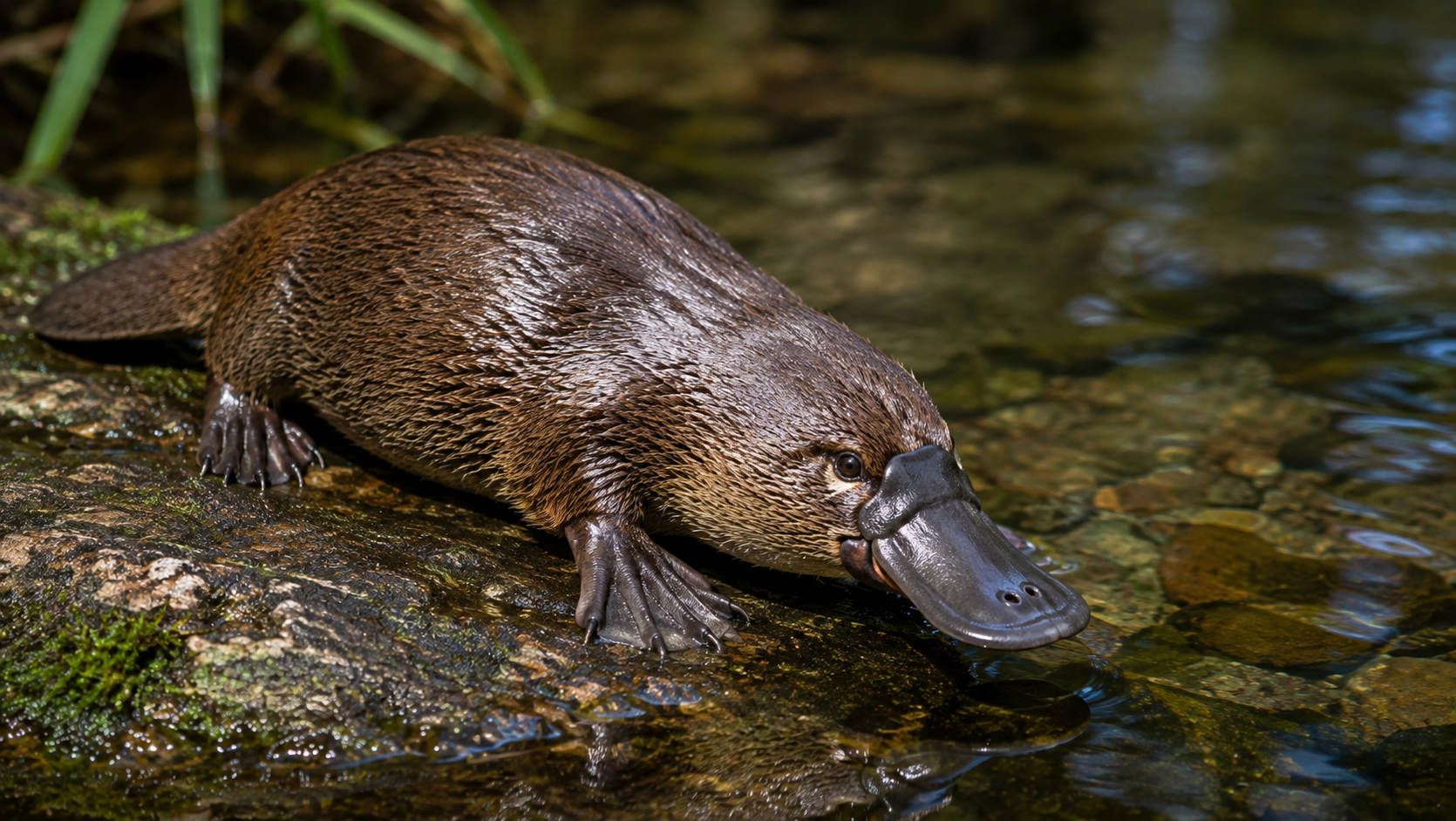
The Duck-billed platypus (Ornithorhynchus anatinus) is a unique and fascinating mammal native to eastern Australia and Tasmania. It is one of the few venomous mammals in the world and is known for its distinctive duck-billed snout, webbed feet, and ability to lay eggs.
The platypus is a relatively small animal, typically growing to about 15-20 inches (38-51 cm) in length and weighing between 1.5-3.5 pounds (0.7-1.6 kg). Its soft, woolly fur is usually brown or gray in color, and it has a distinctive bill that is covered in soft, leathery skin.
Habitat and Distribution
The platypus is found in freshwater habitats, including rivers, streams, lakes, and ponds, in eastern Australia and Tasmania. It is a semi-aquatic animal and spends most of its time in the water, where it forages for food and shelters in burrows or under vegetation.
The platypus is a solitary animal and has a large home range, which it marks with scent to keep other platypuses away. It is a primarily nocturnal animal, but it can be active during the day as well.
Diet and Foraging
The platypus is a carnivorous animal and feeds on a variety of aquatic animals, including insects, crustaceans, and small fish. It uses its bill to search for food in the sediment and its webbed feet to swim and maneuver in the water.
The platypus has a unique way of eating its prey. It stores its food in its cheek pouches and then grinds it up with its bill before swallowing.
Reproduction and Development
The platypus is one of the few mammals that lay eggs instead of giving birth to live young. The female platypus lays 1-3 eggs in a burrow or nesting chamber, which she incubates for about 2 weeks. The eggs hatch into young platypuses, which are blind and hairless at birth.
The young platypuses develop quickly and are able to swim and forage for food on their own after about 3-4 months. They reach maturity at about 1-2 years of age.
Conservation Status
The platypus is listed as Near Threatened on the IUCN Red List, due to habitat loss, pollution, and hunting. Conservation efforts are underway to protect the platypus and its habitat, including the creation of protected areas and education programs.
| Scientific Name | Ornithorhynchus anatinus |
|---|---|
| Length | 15-20 inches (38-51 cm) |
| Weight | 1.5-3.5 pounds (0.7-1.6 kg) |
| Habitat | Freshwater habitats, including rivers, streams, lakes, and ponds |
| Diet | Aquatic animals, including insects, crustaceans, and small fish |
Public Safety and Handling
The platypus is a wild animal and should not be handled or kept as a pet. It has a venomous spur on its hind leg that can deliver a painful and potentially deadly sting.
If you encounter a platypus in the wild, it is best to observe it from a safe distance and not approach it. If you need to handle a platypus for conservation or research purposes, it is essential to wear protective clothing and follow proper handling procedures.
What is the platypus’s unique feature?
The platypus’s unique feature is its ability to lay eggs, making it one of the few mammals that do so.
What is the platypus’s diet?
The platypus is a carnivorous animal and feeds on a variety of aquatic animals, including insects, crustaceans, and small fish.
Is the platypus venomous?
Yes, the platypus has a venomous spur on its hind leg that can deliver a painful and potentially deadly sting.
Can I keep a platypus as a pet?
No, the platypus is a wild animal and should not be kept as a pet. It has complex social and spatial needs that cannot be met in a home environment.
- Australian Government Department of the Environment and Energy. (2020). Platypus.
- International Union for Conservation of Nature. (2020). Ornithorhynchus anatinus.
- National Geographic. (2020). Platypus.
Please note that the information provided in this article is for educational purposes only and should not be used as a substitute for professional veterinary advice. If you have any concerns about the health or well-being of a platypus, please consult a qualified veterinarian or wildlife expert.
Life Cycle and Developmental Stages
The platypus has a unique life cycle, with a complex series of developmental stages. After laying eggs, the female platypus incubates them for about two weeks, during which time she keeps them warm and humid by curling around them and using her bill to maintain a stable temperature. Once the eggs hatch, the young platypuses emerge blind and hairless, relying on their mother’s milk for nutrition. The female platypus produces milk from her mammary glands, which are located on her belly, and the young platypuses lap it up from her fur.
As the young platypuses grow, they begin to develop their unique features, including their bill, webbed feet, and venomous spur. The bill begins to take shape after about six weeks, and the webbed feet develop after about eight weeks. The venomous spur, which is used for defense, develops in males after about 12 weeks. The young platypuses remain dependent on their mother’s milk for several months, eventually weaning after about four to six months.
Communication and Senses
The platypus has a range of unique communication and sensory systems. One of the most interesting is its electrolocation system, which allows it to detect the electrical signals produced by its prey. The platypus has specialized electroreceptors called ampullae of Lorenzini, which are located in its bill and allow it to detect the electrical signals produced by its prey. This system is thought to be particularly useful in murky or dark water, where visibility is limited.
In addition to its electrolocation system, the platypus also has a keen sense of touch and a highly developed sense of smell. Its bill is covered in soft, leathery skin that is highly sensitive to touch, allowing it to detect the slightest movements of its prey. The platypus also has a highly developed sense of smell, which it uses to detect the presence of food and predators.
The platypus also communicates with other platypuses using a range of vocalizations, including clicks, whistles, and growls. These vocalizations are thought to be used for a range of purposes, including mating, territorial defense, and warning other platypuses of potential threats.
Seasonal Variation and Ecological Relationships
The platypus is adapted to a range of seasonal conditions, and its behavior and physiology vary accordingly. In the summer months, the platypus is active during the day and night, foraging for food and sheltering in burrows or under vegetation. In the winter months, the platypus is less active, and its metabolism slows down to conserve energy.
The platypus has a range of ecological relationships with other species in its environment. It is a predator of aquatic invertebrates, including crustaceans, insects, and worms. It also competes with other predators, such as fish and birds, for food and resources. In turn, the platypus is preyed upon by a range of predators, including snakes, goannas, and eagles.
The platypus also plays a key role in maintaining the health of its ecosystem. Its burrowing activities help to aerate the soil and create habitat for other species, while its foraging activities help to regulate the populations of aquatic invertebrates.
Research and Conservation Efforts
The platypus is an important subject of research, particularly in the fields of ecology, conservation biology, and wildlife management. Scientists are working to understand the platypus’s behavior, ecology, and conservation status, and to develop effective conservation strategies.
One of the key areas of research is the impact of environmental change on platypus populations. Climate change, habitat destruction, and pollution are all thought to be major threats to platypus populations, and scientists are working to understand the impacts of these changes and to develop strategies to mitigate them.
Conservation efforts are also underway to protect platypus populations and their habitats. These efforts include the creation of protected areas, such as national parks and wildlife sanctuaries, and the development of conservation plans and management strategies.
Responsible Enrichment and Ethical Considerations
The platypus is a unique and fascinating animal, and it is often kept in captivity for conservation, education, and research purposes. However, keeping platypuses in captivity raises a range of ethical and welfare concerns.
One of the key considerations is the provision of suitable housing and enrichment for platypuses in captivity. Platypuses have complex spatial and behavioral needs, and they require a lot of space and stimulation to thrive. Captive platypuses should be provided with large, naturalistic enclosures that include a range of features, such as burrows, waterways, and vegetation.
Another key consideration is the welfare of platypuses in captivity. Platypuses are sensitive to stress and can be prone to a range of health problems, including respiratory infections and skin lesions. Captive platypuses should be handled gently and carefully, and they should be provided with regular veterinary care and monitoring.
Overall, the platypus is a unique and fascinating animal that requires careful consideration and management. By understanding its behavior, ecology, and conservation status, we can work to protect and conserve this amazing species for future generations.