Addax
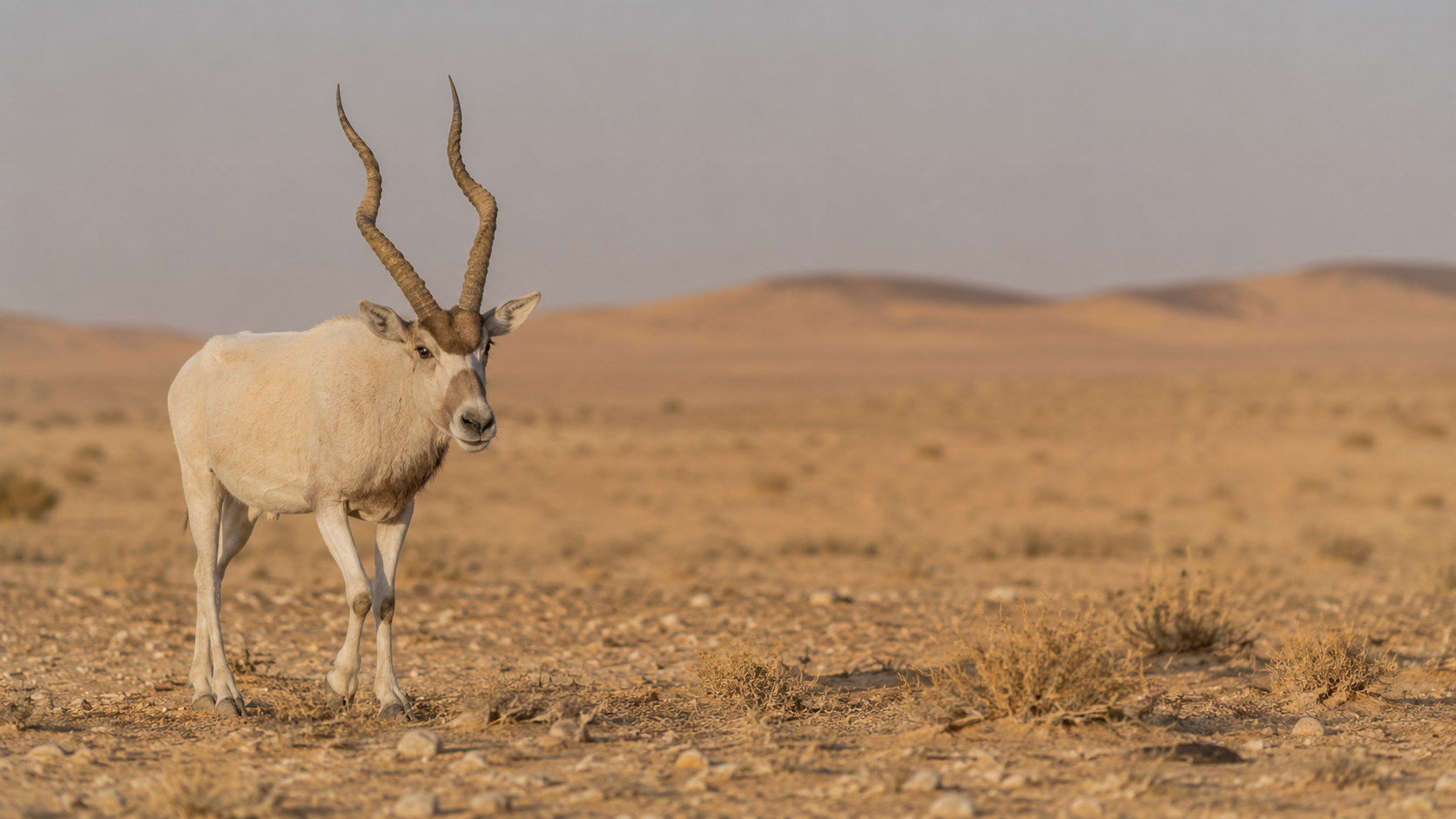
The Addax (Addax nasomaculatus) is a critically endangered desert antelope native to the Sahara Desert in North Africa.
Natural History
The Addax is well adapted to the harsh conditions of the Sahara Desert, with a range that spans across several countries, including Algeria, Chad, Mali, Mauritania, Morocco, Niger, and Tunisia.
They are found in arid and semi-arid regions, where they inhabit sandy dunes, rocky plateaus, and scrublands. Addax are herbivores, feeding on a variety of plants, including grasses, shrubs, and succulents.
Physical Characteristics
The Addax is a medium-sized antelope, with males reaching a height of approximately 100-115 cm (3.3-3.8 ft) at the shoulder and weighing between 100-135 kg (220-298 lbs). Females are slightly smaller, reaching a height of 90-100 cm (3-3.3 ft) and weighing between 60-100 kg (132-220 lbs).
They have a distinctive pair of long, twisted horns that can grow up to 120 cm (3.9 ft) in length, which are used for defense and intimidation. Their coat is grayish-brown in color, with a white underbelly and a black stripe running along their back.
| Characteristic | Value |
|---|---|
| Scientific Name | Addax nasomaculatus |
| Conservation Status | Critically Endangered |
| Height (Males) | 100-115 cm (3.3-3.8 ft) |
| Weight (Males) | 100-135 kg (220-298 lbs) |
| Weight (Females) | 60-100 kg (132-220 lbs) |
| Horn Length | Up to 120 cm (3.9 ft) |
Behavior and Social Structure
Addax are social animals and are often found in small groups, typically consisting of females and their young. Males will often wander on their own or form bachelor groups.
They are nomadic, traveling long distances in search of food and water. Addax are also skilled at conserving water, able to go without drinking for long periods of time.
Conservation Status
The Addax is listed as Critically Endangered on the IUCN Red List, with estimates suggesting that there are fewer than 100 individuals remaining in the wild.
The main threats to their survival include habitat loss and fragmentation, hunting, and competition with domestic livestock for food and water.
Responsible Observation and Conservation
Due to the critically endangered status of the Addax, it is essential to observe them responsibly and support conservation efforts.
Visitors to the Sahara Desert can support local conservation initiatives and respect the animals’ habitat by not littering, not approaching them, and not feeding them.
What is the main threat to the Addax population?
The main threats to the Addax population include habitat loss and fragmentation, hunting, and competition with domestic livestock for food and water.
How many Addax are estimated to remain in the wild?
Estimates suggest that there are fewer than 100 individuals remaining in the wild.
What is the Addax’s adaptation to conserve water?
The Addax is able to conserve water by going without drinking for long periods of time.
What is the typical height of a male Addax?
Males reach a height of approximately 100-115 cm (3.3-3.8 ft) at the shoulder.
- IUCN Red List: Addax nasomaculatus
- UNEP-WCMC: Addax nasomaculatus
- WWF: Addax
Important Notice: The Addax is a wild animal and should not be approached or handled. If you are concerned about the health or well-being of an Addax, please contact a local wildlife authority or conservation organization.
Life Cycle
The Addax has a unique life cycle that is adapted to the harsh conditions of the Sahara Desert. They are able to breed year-round, but the peak breeding season typically occurs during the wet season when food is more abundant. Female Addax give birth to a single calf after a gestation period of approximately 9-10 months. The calf is born with a thick coat of hair and is able to walk within the first hour of birth. The female Addax will often leave her calf in a hidden location, such as a thicket or a rocky outcropping, while she goes out to graze. This behavior is thought to be an adaptation to protect the calf from predators.
Communication and Senses
Addax have a range of communication methods that are adapted to their desert environment. They use a variety of vocalizations, including grunts, snorts, and bleats, to communicate with each other. They also use body language, such as posturing and horn displays, to establish dominance and attract mates. Addax have a keen sense of smell, which they use to detect predators and find food. They also have excellent eyesight, which helps them to detect potential threats from a distance.
Seasonal Variation
Addax are well adapted to the seasonal changes in the Sahara Desert. During the wet season, they are able to take advantage of the abundant food sources and will often put on weight. During the dry season, they will often go without water for long periods of time, surviving on the moisture from the plants they eat. Addax will also change their behavior during the different seasons, often moving to higher elevations during the hot summer months to escape the heat.
Ecological Relationships
Addax play an important role in the ecosystem of the Sahara Desert. They are a key food source for many predators, including leopards, hyenas, and jackals. They also help to disperse seeds and nutrients through their grazing activities. Addax are also an important part of the cultural heritage of the people who live in the Sahara Desert, and are often featured in local folklore and art.
Research
Research on Addax is ongoing, with scientists working to better understand their behavior, ecology, and conservation status. Studies have shown that Addax are able to survive in a variety of different habitats, from sandy dunes to rocky plateaus. Research has also shown that Addax are able to go without water for long periods of time, surviving on the moisture from the plants they eat.
Responsible Enrichment
Addax are often kept in zoos and wildlife parks, where they are provided with a range of enrichment activities to stimulate their natural behavior. These activities can include providing them with a variety of different foods, such as hay and grains, as well as toys and puzzles to keep them stimulated. Addax are also provided with a range of different habitats, such as sandy enclosures and rocky outcroppings, to mimic their natural environment.
Ethical and Legal Considerations
Addax are protected by a range of laws and international agreements, including the Convention on International Trade in Endangered Species of Wild Fauna and Flora (CITES) and the Convention on Migratory Species (CMS). The capture and trade of Addax is strictly regulated, and they are considered to be a priority species for conservation efforts. Efforts are being made to protect the Addax and their habitat, including the establishment of protected areas and the development of sustainable land-use plans.
**Habitat and Distribution**
The Addax is found in the arid and semi-arid regions of the Sahara Desert, where they inhabit sandy dunes, rocky plateaus, and scrublands. They are widely distributed across North Africa, with a range that spans across several countries, including Algeria, Chad, Mali, Mauritania, Morocco, Niger, and Tunisia. The Addax is well adapted to the harsh conditions of the Sahara Desert, where they can be found in areas with limited vegetation and water sources.
**Diet and Nutrition**
Addax are herbivores, and their diet consists of a variety of plants, including grasses, shrubs, and succulents. They are able to survive for long periods without water, obtaining moisture from the plants they eat. In the wild, they feed on a variety of plants, including the leaves and stems of desert shrubs, as well as the fruits and flowers of succulents. In captivity, they are typically fed a diet of hay, grains, and vegetables.
**Reproduction and Breeding**
Addax are polygynous, with males engaging in a variety of behaviors to attract females, including loud calls, foot-stamping, and horn-clashing. Females typically give birth to a single young after a gestation period of approximately 9 months. The young are able to walk within the first hour of birth and are weaned after several months. In captivity, Addax are typically bred in the spring and summer months, with a breeding program in place to help conserve the species.
**Threats and Conservation Efforts**
The Addax is listed as Critically Endangered on the IUCN Red List, due to a variety of threats, including habitat loss and fragmentation, hunting, and competition with domestic livestock. Conservation efforts are underway to protect the Addax and its habitat, including the establishment of protected areas and the implementation of sustainable land-use practices. In addition, a number of organizations are working to breed the Addax in captivity, with the goal of releasing animals back into the wild to augment declining populations.
**Cultural Significance**
The Addax has cultural significance in North Africa, where it is considered a symbol of the Sahara Desert and its people. In some cultures, the Addax is considered a sacred animal, associated with strength, beauty, and fertility. In addition, the Addax has been featured in a number of works of art and literature, including traditional songs and stories.
**Research and Monitoring**
Research is being conducted to better understand the ecology and behavior of the Addax, including its habitat use, diet, and social structure. In addition, monitoring programs are in place to track the population size and trend of the Addax, as well as the effectiveness of conservation efforts. This research and monitoring is important for the development of effective conservation strategies and for the long-term survival of the species.
**Responsible Captivity**
In captivity, the Addax is typically kept in large enclosures that mimic its natural habitat. In these enclosures, the Addax is able to roam freely and engage in natural behaviors, such as foraging and socializing. In addition, the Addax is provided with a diet that is similar to its natural diet, including hay, grains, and vegetables. Captivity programs are in place to breed the Addax and to educate the public about the species and its conservation status.