Northern Quoll
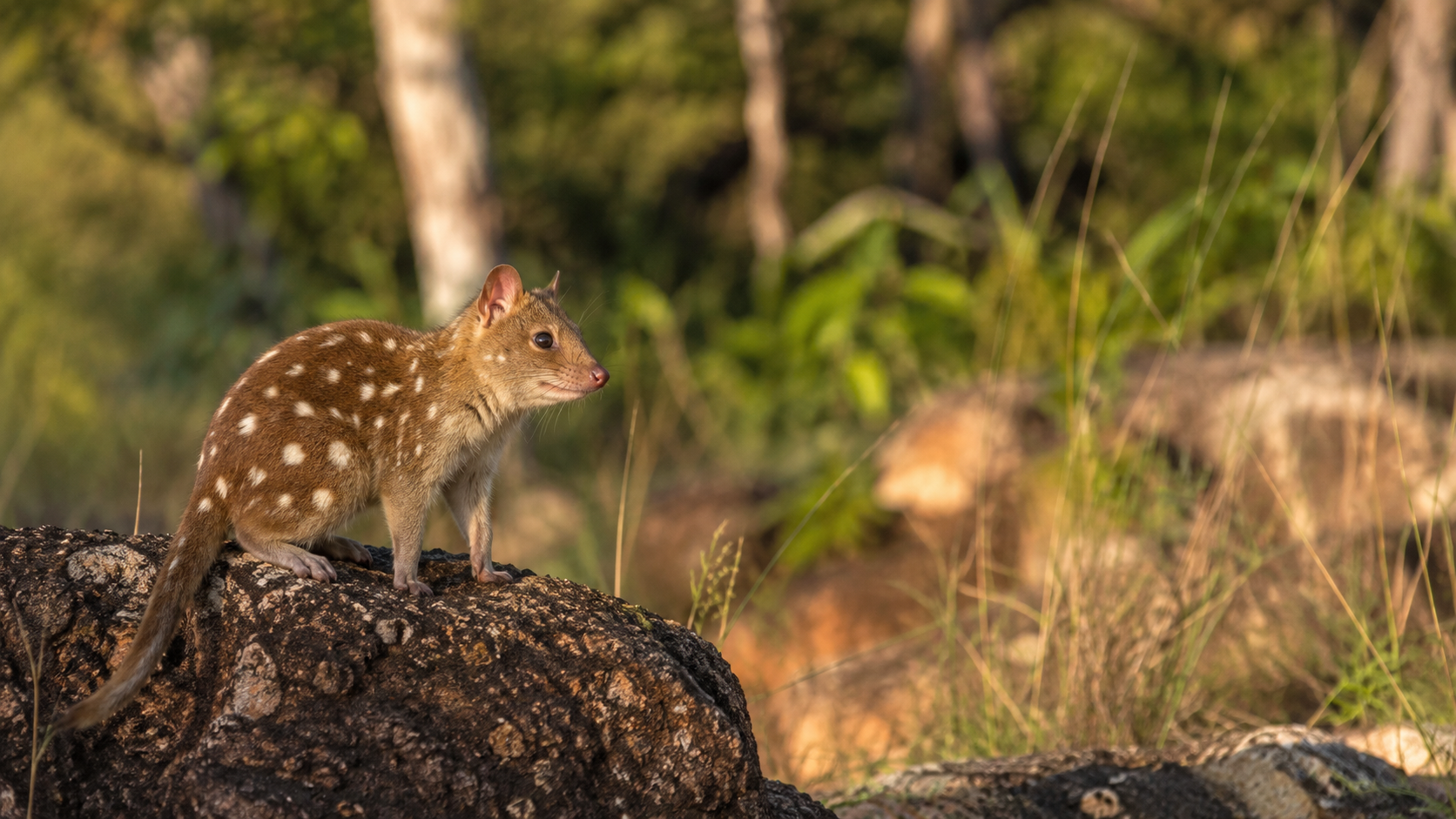
The Northern Quoll (Dasyurus hallucatus) is a carnivorous marsupial native to northern Australia and southern New Guinea.
Classification and Evolution
The Northern Quoll is a member of the family Dasyuridae, which includes other carnivorous marsupials such as the Tasmanian Devil and the Eastern Quoll.
Physical Characteristics
The Northern Quoll has a stout body, typically 35-55 cm in length, with a weight range of 0.7-2.5 kg. It has a distinctive white-spotted brown coat, with a long, thin tail.
| Characteristic | Description |
|---|---|
| Body length | 35-55 cm |
| Weight | 0.7-2.5 kg |
| Coat color | Brown with white spots |
| Tail length | Up to 30 cm |
Habitat and Distribution
The Northern Quoll is found in the tropical savannas and grasslands of northern Australia, including the Northern Territory, Western Australia, and Queensland. It is also found in southern New Guinea.
Diet and Foraging
The Northern Quoll is a carnivore, feeding on small mammals, reptiles, amphibians, and insects. It is an opportunistic hunter, using its keen senses and powerful jaws to catch its prey.
Conservation Status
The Northern Quoll is listed as Endangered on the IUCN Red List, due to habitat loss, predation by introduced predators, and other human activities.
Behavior and Social Structure
Northern Quolls are primarily solitary animals, only coming together for mating. They are nocturnal, spending most of their time resting or foraging at night.
Reproduction and Development
Northern Quolls breed in the wet season, with females giving birth to 2-8 young after a short gestation period. The young then develop in the mother’s pouch before venturing out on their own.
What is the main threat to Northern Quoll populations?
Habitat loss and fragmentation, as well as predation by introduced predators such as cats and foxes.
What is the typical lifespan of a Northern Quoll in the wild?
Up to 5 years, although the average lifespan is around 2-3 years.
Are Northern Quolls good pets?
No, Northern Quolls are wild animals that have complex social and spatial needs that cannot be met in a domestic setting.
How can I help conserve Northern Quolls?
Support conservation efforts by donating to reputable organizations, spreading awareness about the species, and reducing your carbon footprint to mitigate climate change.
- Australian Government Department of the Environment and Energy. (2020). Northern Quoll.
- IUCN Red List. (2020). Dasyurus hallucatus.
- Queensland Government Department of Environment and Science. (2020). Northern Quoll.
Please note that the information provided is for educational purposes only and should not be used as a substitute for professional veterinary advice. If you have any concerns about the health or well-being of a Northern Quoll, please consult a qualified veterinarian or wildlife expert.
### Life Cycle
The Northern Quoll’s life cycle is typical of many marsupials. The female gives birth to a litter of 2-8 young after a short gestation period of about 21 days. The young then crawl up to the mother’s pouch, where they continue to develop and nurse for several months. The female Northern Quoll’s pouch is well-developed, with a strong sphincter muscle that allows her to seal the pouch and protect her young from predators. After about 6-7 months, the young quolls leave the pouch and start to venture out on their own, although they may still return to their mother for food and shelter. The young quolls reach sexual maturity at around 12-18 months, and can live for up to 5-7 years in the wild.
### Communication and Senses
Northern Quolls have a range of communication methods, including vocalizations, scent marking, and visual displays. They are primarily nocturnal, but can be active during the day as well. They have poor eyesight, but their sense of smell is highly developed, and they use scent marking to communicate with other quolls. They also have a keen sense of hearing, and can detect the slightest sounds. In terms of visual displays, Northern Quolls will often arch their back and raise their hackles when threatened or during courtship.
### Seasonal Variation
Northern Quolls do not truly hibernate, but they do experience a period of torpor during the dry season, when food is scarce. During this time, their metabolism slows down, and they may go for extended periods without food or water. When the wet season arrives, and food becomes more abundant, the quolls will emerge from their torpor and start to forage and breed again.
### Ecological Relationships
Northern Quolls play a crucial role in their ecosystem as both predators and prey. They feed on small mammals, reptiles, and insects, helping to regulate their populations. In turn, they are preyed upon by larger predators such as dingos, eagles, and snakes. They also compete with other predators, such as feral cats and foxes, for food and resources.
### Research
Research on Northern Quolls is ongoing, with scientists studying their behavior, ecology, and conservation biology. One area of research is focused on the impact of climate change on quoll populations, and how they adapt to changing environmental conditions. Another area of research is on the development of effective conservation strategies, such as habitat restoration and predator control.
### Responsible Enrichment
In zoos and wildlife sanctuaries, Northern Quolls require enrichment activities to stimulate their natural behavior and provide mental and physical stimulation. This can include providing them with puzzle feeders, hiding food and toys, and creating complex enclosures that mimic their natural habitat. By providing enrichment activities, zoos and sanctuaries can help to promote the welfare and well-being of Northern Quolls in captivity.
### Ethical and Legal Considerations
The Northern Quoll is listed as Endangered on the IUCN Red List, and is protected by law in Australia and New Guinea. The export of Northern Quolls is strictly regulated, and they are not commonly kept as pets. In fact, it is illegal to keep Northern Quolls as pets in many countries, due to their complex social and spatial needs, and the risk of them escaping and establishing feral populations.
Life Cycle and Development
The Northern Quoll’s life cycle is characterized by a relatively short gestation period and a prolonged period of juvenile dependence. Female Northern Quolls give birth to 2-8 young after a gestation period of approximately 21 days. The young are born blind and hairless, but develop quickly, opening their eyes after about 50 days and leaving the pouch after around 60 days. The young quolls remain dependent on their mother for several months, eventually becoming independent at around 6-7 months of age.
During this period, the mother provides them with milk, protection, and essential skills for survival. The young quolls learn important behaviors, such as hunting and foraging, by observing and imitating their mother. As they mature, they begin to venture away from their mother’s territory, eventually establishing their own home ranges.
Communication and Senses
Northern Quolls possess a range of adaptations that enable them to communicate effectively and navigate their environment. They have a keen sense of smell, which they use to detect prey, mark territories, and recognize other quolls. They also possess excellent hearing and vision, allowing them to detect potential threats and locate food sources.
In terms of communication, Northern Quolls use a variety of vocalizations, including clicks, chirps, and whistles, to convey information and express emotions. They also use scent marking to communicate with other quolls, depositing pheromones on rocks, trees, and other objects to convey information about their identity, sex, and reproductive status.
Seasonal Variation and Ecological Relationships
The Northern Quoll’s behavior and ecology vary significantly across different seasons. During the wet season, quolls are more active and abundant, taking advantage of the increased availability of food and water. They feed on a wide range of prey, including insects, small mammals, and reptiles, which are more active during this time.
In contrast, during the dry season, quolls become more sedentary and solitary, relying on cached food stores and water sources to survive. They also exhibit a range of adaptations to conserve energy and water, such as reducing their activity levels and using burrows and other sheltered sites to escape the heat.
Northern Quolls play a crucial role in their ecosystems, serving as both predators and prey for other animals. They prey on a range of invertebrates and small vertebrates, helping to regulate their populations and maintain ecosystem balance. In turn, quolls are preyed upon by larger predators, such as dingos, eagles, and snakes, which helps to regulate their own populations.
Research and Conservation Efforts
Conservation efforts for the Northern Quoll are ongoing, with researchers and conservationists working to address the key threats facing the species. One major focus area is the control of introduced predators, such as cats and foxes, which prey on quolls and compete with them for food and resources.
Researchers are also working to develop effective conservation breeding programs, which aim to increase the population size and genetic diversity of the species. These programs involve the captive breeding of quolls, as well as the release of captive-bred animals into the wild.
In addition, conservationists are working to protect and restore quoll habitats, including the creation of wildlife corridors and the control of invasive vegetation. These efforts aim to provide quolls with the habitat and resources they need to survive and thrive.
Responsible Enrichment and Welfare
For individuals interested in keeping Northern Quolls in captivity, it is essential to prioritize their welfare and provide them with suitable enrichment opportunities. This includes providing a large, escape-proof enclosure with adequate space for movement and exercise, as well as a varied and nutritious diet that meets their nutritional needs.
Quolls also require mental stimulation and enrichment, which can be provided through the use of puzzle toys, hiding places, and other forms of environmental enrichment. It is also essential to provide quolls with opportunities for social interaction, as they are social animals that thrive in the company of others.
In terms of handling, quolls are generally not considered suitable pets, as they have complex social and spatial needs that are difficult to meet in a domestic setting. However, for experienced animal handlers and conservationists, quolls can make rewarding and engaging animals to work with, providing opportunities for education, research, and conservation.