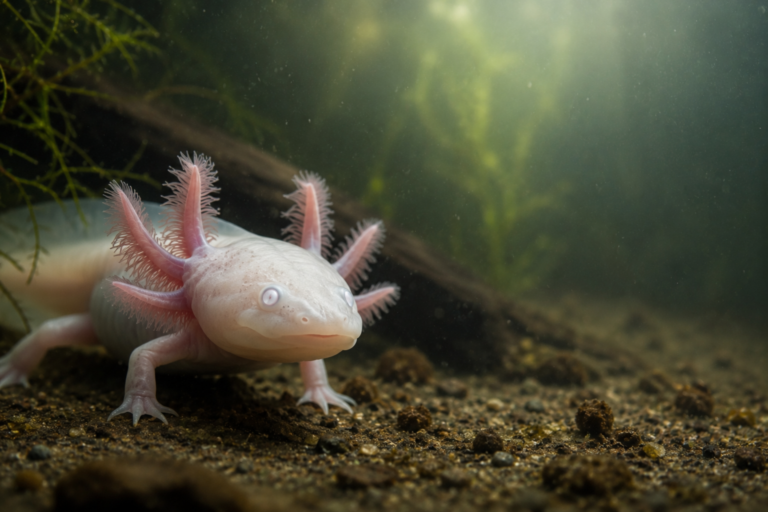
The feathery structures beside an axolotl’s head are external gills. They are also the first clue to understanding this animal: it is not a fish or a reptile, but an aquatic salamander whose natural history is closely tied to Xochimilco in Mexico City.
At a glance
| Key detail | What to know |
|---|---|
| Scientific name | Ambystoma mexicanum |
| Animal group | Amphibian; order Caudata, the salamanders and newts |
| Native range | The lake and canal system of Xochimilco, Mexico City |
| Distinctive biology | Usually remains aquatic and retains external gills throughout adult life |
| General diet | Carnivorous; small aquatic animals and invertebrates |
| Conservation context | Wild populations face habitat change, pollution and introduced species |
What exactly is an axolotl?
The axolotl is a species of mole salamander. Its scientific name, Ambystoma mexicanum, places it among amphibians, alongside frogs, toads, newts and other salamanders. Amphibians generally have permeable skin and life cycles strongly connected to water. Reptiles, by contrast, have different skin, egg and respiratory adaptations. The axolotl’s external gills, salamander body plan and taxonomy make its classification unambiguous: it belongs in the Amphibians category, not Reptiles.
The word “axolotl” comes from Nahuatl and the species has a deep cultural association with Mexico. Its unusual appearance made it famous worldwide, but popularity in aquariums should not distract from the precarious situation of axolotls in their native habitat.
Why does it seem to stay young?
Most salamanders begin life as aquatic larvae and later undergo metamorphosis, losing their external gills as their bodies adapt to life on land. Axolotls usually follow a different route. They reach sexual maturity while retaining several larval characteristics, especially their feathery external gills, finned tail and aquatic lifestyle. This phenomenon is called paedomorphosis, often discussed as neoteny.
That does not mean an adult axolotl is literally a baby. It is a mature animal with a specialised life history. Describing it as “forever young” is a useful introduction, but the biological reality is more interesting: development and reproductive maturity do not always follow the same timetable.
A body designed for life underwater
The three branching structures visible on either side of the head are external gills. Their many fine filaments provide a large surface through which oxygen can move from water into the bloodstream. Axolotls can also exchange gases through their skin and use simple lungs, sometimes rising to the surface for air. This combination is well suited to quiet aquatic environments.
A long fin runs along the tail and helps the animal move through the water. Its small limbs are used for balance and walking along the bottom rather than fast swimming. Colour varies. Wild axolotls are generally dark and mottled, helping them blend into the substrate. The pale pink, white or golden animals often seen online are captive colour forms and are not representative of most wild individuals.
The last wild home: Xochimilco
Axolotls are native to the ancient lake system of the Valley of Mexico. Today their best-known remaining wild habitat is the network of canals and wetlands at Xochimilco. This landscape is biologically important and culturally distinctive, with traditional agricultural islands known as chinampas.
Urban growth profoundly changed the original lakes. Water quality, canal structure and the quantity of suitable habitat have all been affected. Introduced fish, including carp and tilapia, can compete with axolotls for food and may eat their eggs or young. Pollution and fragmented habitat add further pressure. Conservation therefore requires more than breeding animals in tanks: it depends on restoring a functioning wetland ecosystem and working with the communities who live around it.
What do axolotls eat?
In the wild, axolotls are opportunistic carnivores. They consume worms, insect larvae, small crustaceans, molluscs and other suitably sized aquatic prey. Rather than chewing, they use rapid suction to pull food into the mouth. Their small teeth mainly help them grip.
Captive feeding is not simply a matter of copying a list from the internet. Food size, nutritional quality, frequency and water contamination all matter, and needs change with age and condition. Anyone responsible for a captive axolotl should obtain species-specific guidance from an experienced exotic-animal veterinarian or a reputable husbandry organisation. Leftover food should not be allowed to decay and damage water quality.
Regeneration: remarkable, but not magic
Axolotls are famous in scientific research because they can regenerate complex structures, including portions of limbs, tail, spinal cord and some other tissues, with less scarring than mammals. Researchers study the cellular signals involved in this process in the hope of understanding tissue repair more broadly.
Regeneration does not make an axolotl indestructible or remove its capacity to suffer. Injury, infection, toxic water conditions and chronic stress remain serious welfare problems. An animal should never be deliberately injured to “test” this ability. The responsible lesson from regeneration is scientific curiosity and respect, not experimentation at home.
Essential needs in human care
| Area | General reference | Why it matters |
|---|---|---|
| Aquarium | Fully cycled, stable and with sufficient floor space | Reduces exposure to harmful fluctuations and supports normal movement |
| Water | Cool, tested regularly and moved by gentle filtration | Temperature and water chemistry directly affect amphibian welfare |
| Interior | Secure hides and no swallowable gravel or sharp decoration | Helps prevent obstruction and injuries to skin or gills |
| Handling | Observation first; physical handling only when necessary | Protects sensitive skin and its mucus layer |
| Professional support | Veterinarian experienced with amphibians or exotic animals | Warning signs require individual assessment, not online diagnosis |
Keeping an axolotl is a long-term specialist commitment. It needs a fully cycled aquarium, stable cool water, appropriate filtration with limited current, enough floor space, secure hides and regular testing of water parameters. Sudden changes in temperature or water chemistry can be dangerous. Gravel small enough to swallow can cause obstruction, while rough decoration can damage delicate skin and gills.
Axolotls should be observed without excessive handling. Their skin and protective mucus layer are sensitive, and handling is stressful. Tank mates can bite their exposed gills or become prey, so companionship decisions demand particular care. Local laws and sourcing also matter: a prospective keeper should confirm that ownership is legal and choose only a documented captive-bred animal, never one removed from the wild.
Signs that require professional help
Changes in appetite, repeated floating problems, loss or damage to gill filaments, skin lesions, swelling, unusual posture, persistent curling of the gills or tail, and sudden inactivity can indicate a husbandry or health problem. These signs are not diagnoses. Check the environment promptly and contact a veterinarian with amphibian or exotic-animal experience. Do not add salt, medication, antibiotics or other treatments based on an anonymous post: amphibians readily absorb substances through their skin, and an unsuitable dose can cause harm.
Why captive abundance does not equal safety in nature
There are many axolotls in laboratories and private collections, but a large captive population does not replace a healthy wild population. Captive lines may have limited genetic diversity or traits selected for captivity. They also do not perform the ecological role of axolotls in Xochimilco. Releasing pets is not a solution; it can introduce disease, unsuitable genetics or animals unable to survive.
Useful support focuses on habitat restoration, clean water, responsible local agriculture, biosecurity and well-designed conservation programmes. Visitors and consumers can help by learning about Xochimilco, supporting credible conservation organisations and refusing wildlife of uncertain origin.
Frequently asked questions
Is an axolotl a reptile?
No. It is an amphibian and, more specifically, a salamander. External gills and an aquatic life do not make it a fish.
Can an axolotl live on land?
The normal form remains aquatic. Metamorphosis can occur under unusual conditions, but inducing it is risky and should never be attempted as a novelty.
Why are captive axolotls often pink?
Selective breeding produced pale colour forms in captivity. Wild individuals are generally darker, which helps them blend into their surroundings.
Can I touch one?
Routine handling is inappropriate. Move the animal only when genuinely necessary and according to guidance from an experienced professional.
Sources and further reading
- American Museum of Natural History: the axolotl as a unique amphibian
- San Diego Zoo Wildlife Alliance: axolotl species profile
- Animal Diversity Web: Ambystoma mexicanum
- CONABIO: information on the Mexican axolotl
Responsible information notice
This article is educational. It does not replace a diagnosis, treatment plan or husbandry assessment by a qualified veterinarian. If an animal is unwell, contact a professional with amphibian experience.