Natural History
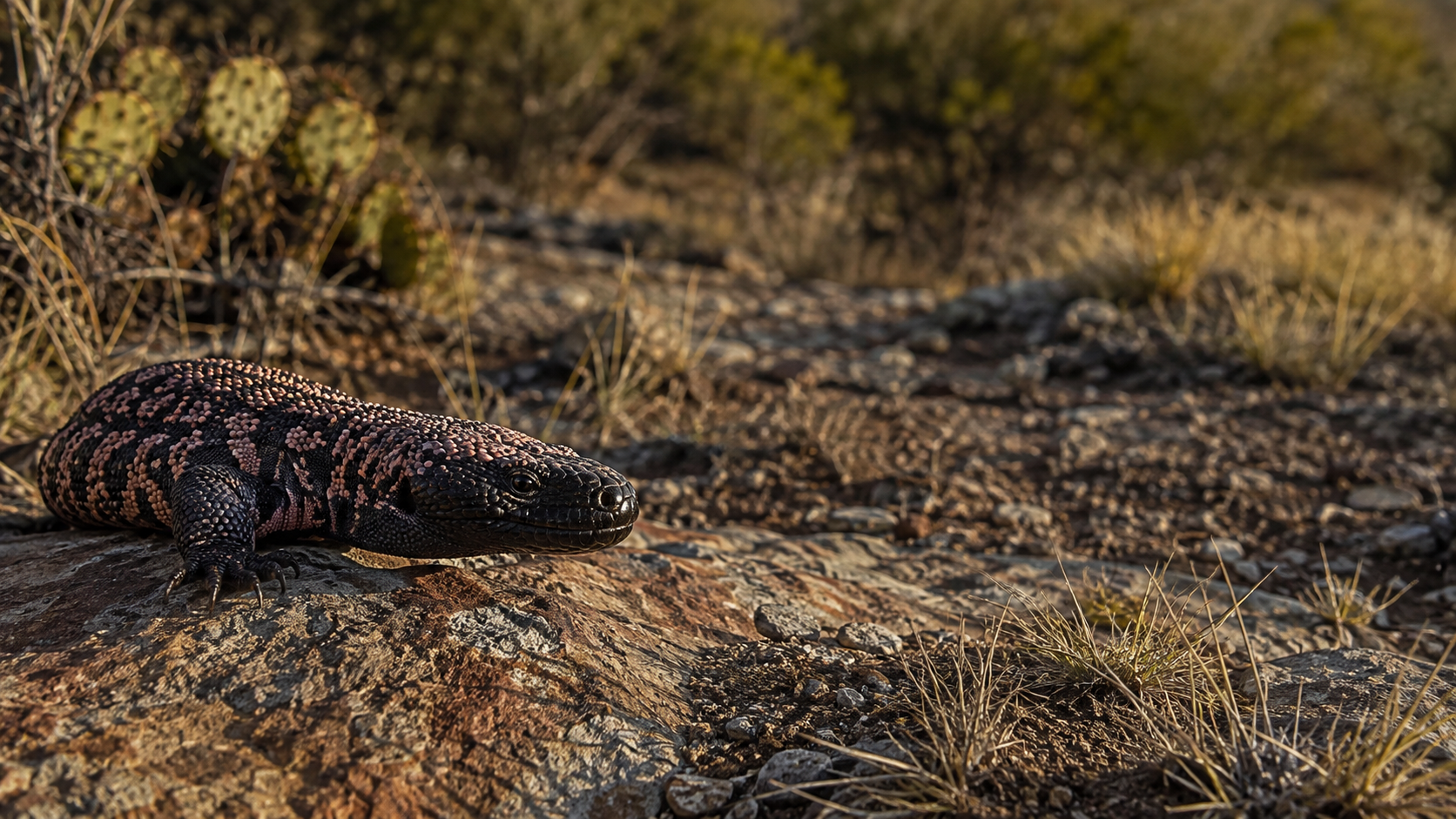
The Gila Monster (Heloderma suspectum) is a venomous lizard native to the southwestern United States and northwestern Mexico. It is a member of the beaded lizard family (Helodermatidae) and is one of the two species of venomous lizards found in North America.
Gila Monsters are relatively small, typically growing to 18-22 inches (45-55 cm) in length, including their tail. They have a stout body, a broad head, and a distinctive pattern of pink, yellow, and black markings on their back. They are well adapted to their desert habitat, with a stocky build and powerful claws that allow them to dig burrows and climb rocks.
Habitat and Distribution
Gila Monsters are found in the deserts and dry forests of the southwestern United States, including Arizona, New Mexico, and Texas, as well as in northwestern Mexico. They are typically found in areas with rocky outcroppings, scrubby vegetation, and sandy soil.
They are ectothermic, meaning that they regulate their body temperature using external sources, such as the sun or a warm rock, rather than generating heat internally. This allows them to conserve energy and survive in their hot, dry environment.
Diet and Foraging
Gila Monsters are carnivores, feeding on a variety of small animals, including eggs, nestlings, and insects. They have a keen sense of smell and can detect the presence of food using their highly developed olfactory system.
They are also known to eat carrion, and will scavenge for food in the absence of live prey. In captivity, they are typically fed a diet of crickets, mealworms, and other insects.
Behavior and Social Structure
Gila Monsters are generally solitary animals, only coming together to mate. They are territorial, and will defend their territory from other Gila Monsters using a variety of displays, including hissing, growling, and biting.
They are also skilled climbers, and will often climb trees or rocks to bask in the sun or escape predators.
Conservation Status
Gila Monsters are listed as Near Threatened on the IUCN Red List, due to habitat loss, fragmentation, and degradation, as well as collection for the pet trade. They are also protected by law in some states, including Arizona and New Mexico.
Public Safety
Gila Monsters are venomous, and their bite can be painful and potentially serious. They are not typically aggressive, but will bite if threatened or provoked.
If you encounter a Gila Monster in the wild, it is best to leave it alone and give it plenty of space. If you are bitten, seek medical attention immediately.
| Scientific Name | Heloderma suspectum |
|---|---|
| Family | Helodermatidae |
| Order | Squamata |
| Class | Reptilia |
| Conservation Status | Near Threatened |
FAQ
What is the average lifespan of a Gila Monster?
20-30 years in the wild, up to 40 years in captivity.
Are Gila Monsters good pets?
No, Gila Monsters are wild animals that have complex social and spatial needs that cannot be met in a home environment. They are also venomous and require specialized care.
How can I tell if a Gila Monster is venomous?
All Gila Monsters are venomous, and their venom is delivered through their bite. If you are bitten, seek medical attention immediately.
Can I handle a Gila Monster in the wild?
No, it is not recommended to handle Gila Monsters in the wild. They are wild animals that can bite and may carry diseases.
- Arizona Game and Fish Department. (2020). Gila Monster.
- International Union for Conservation of Nature. (2020). Heloderma suspectum.
- Smith, H. M., & Taylor, E. H. (1950). An annotated checklist and key to the reptiles of Mexico exclusive of the snakes. Bulletin of the United States National Museum, 199, 1-253.
Important Notice: If you suspect that your pet has ingested a Gila Monster or has been bitten by one, please contact your veterinarian or a pet poison hotline immediately.
Life Cycle and Development
Gila Monsters have a unique life cycle, with a complex process of growth and development. They are oviparous, laying eggs in the spring and summer months. Female Gila Monsters will typically lay 2-5 eggs in a nesting burrow, which they will guard until the eggs hatch after an incubation period of around 120-130 days. The hatchlings will emerge from the eggs in late summer or early fall, and will be around 6-8 inches (15-20 cm) in length.
The young Gila Monsters will go through a series of shedding cycles as they grow, during which they will shed their skin in patches. This process allows them to increase in size and develop their distinctive pattern of markings. As they mature, they will also develop their venom glands, which are located in the lower jaw and are used for defense.
Gila Monsters can live for up to 20-30 years in the wild, although the average lifespan is around 10-15 years. In captivity, with proper care and management, they can live for 20-30 years or more.
Communication and Senses
Gila Monsters have a range of communication methods, including visual, auditory, and chemical signals. They use a variety of body language cues, such as posturing and threat displays, to communicate with other Gila Monsters. They will also use scent markings to communicate with other members of their species, particularly during the mating season.
Gila Monsters have a keen sense of smell, which they use to detect food and predators. They also have excellent eyesight, and can detect movement and changes in their surroundings. Their sense of hearing is less well-developed, but they are able to detect vibrations and low-frequency sounds.
One of the most interesting aspects of Gila Monster communication is their use of seismic signals. They are able to detect the vibrations caused by the movement of other animals, and can use this information to locate prey or detect potential threats.
Seasonal Variation
Gila Monsters are adapted to the hot and dry conditions of the desert environment, and have a range of physiological and behavioral adaptations that allow them to survive in this environment. During the summer months, they will typically be active at night, and will spend the day hiding in burrows or under rocks to avoid the heat.
In the winter months, Gila Monsters will enter a state of dormancy, known as brumation, during which their metabolism slows down and they conserve energy. This allows them to survive the cold temperatures and lack of food during the winter months.
Gila Monsters will also adjust their diet and foraging behavior according to the season. During the summer months, they will feed on a wide range of insects, eggs, and small vertebrates. In the winter months, they will rely on stored fat reserves and will not eat as much.
Ecological Relationships
Gila Monsters play an important role in their ecosystem, serving as both predators and prey. They feed on a range of insects, eggs, and small vertebrates, and are an important food source for larger predators such as coyotes, bobcats, and hawks.
Gila Monsters also have a range of symbiotic relationships with other species. For example, they have a mutualistic relationship with certain species of ants, which will often live in their burrows and provide them with food and protection.
Gila Monsters are also an important part of the desert ecosystem, helping to control populations of insects and small vertebrates. They are also an important indicator species, providing insights into the health and biodiversity of their ecosystem.
Research and Conservation Efforts
Gila Monsters are an important species for research, particularly in the fields of ecology, conservation biology, and herpetology. Scientists are studying their behavior, ecology, and physiology in order to better understand their role in the ecosystem and to develop effective conservation strategies.
Conservation efforts are underway to protect Gila Monsters and their habitats. The species is listed as Near Threatened on the IUCN Red List, and is protected by law in many parts of its range. Habitat preservation and restoration efforts are also underway, aimed at protecting the rocky outcroppings, scrubby vegetation, and sandy soil that Gila Monsters rely on.
In addition, many zoos and wildlife sanctuaries are working to breed Gila Monsters in captivity, in order to release them back into the wild and augment declining populations. These programs also provide an important opportunity for education and outreach, helping to raise awareness about the importance of conservation and the plight of this unique and fascinating species.
Responsible Enrichment and Captive Care
Gila Monsters are popular pets, and many people are interested in keeping them in captivity. However, it is essential to provide them with proper care and enrichment in order to ensure their health and well-being.
In captivity, Gila Monsters require a large enclosure with plenty of space to move around, climb, and dig. They also require a varied diet that includes a range of insects, eggs, and small vertebrates. A temperature range of 75-90°F (24-32°C) and a humidity level of 30-50% are also essential.
Providing enrichment activities, such as hiding food or providing puzzle toys, can help to stimulate Gila Monsters and reduce stress. Handling should be kept to a minimum, as Gila Monsters can be stressed by excessive handling.
It is also essential to ensure that Gila Monsters are obtained from reputable breeders or rescue organizations, and that all local laws and regulations are followed.