Quick Reference Table
| Scientific Name | Plestiodon elegans |
|---|---|
| Length | 10-13 cm (4-5 in) |
| Weight | 10-20 g (0.4-0.7 oz) |
| Lifespan | 5-7 years |
Taxonomy and Identification
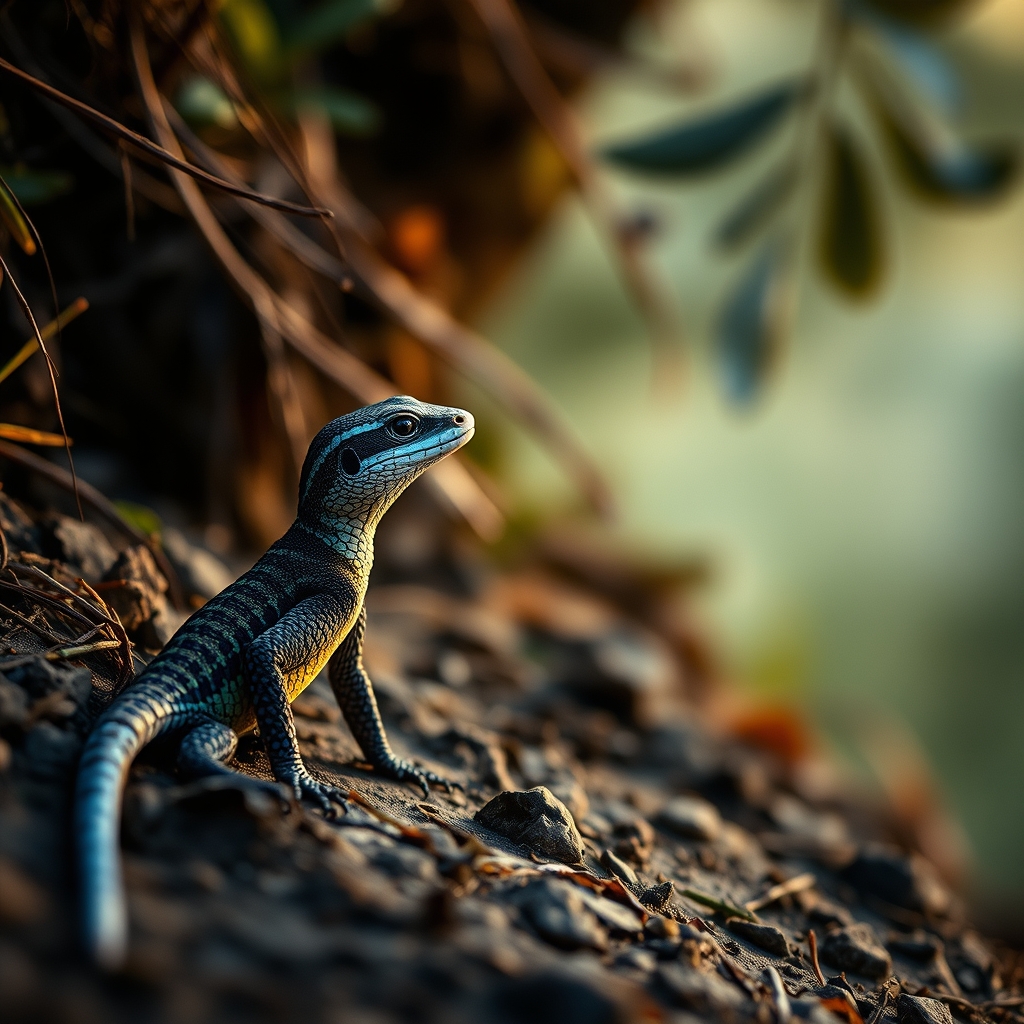
The Blue-tailed Skink (Plestiodon elegans) is a species of lizard in the family Scincidae. It is also known as the Five-lined Skink due to the five yellowish stripes on its back. The Blue-tailed Skink is a relatively small, slender lizard with a broad, flat head and a long, thin tail that is typically blue in colour, especially in young individuals.
Adult Blue-tailed Skinks have a brown or greyish-brown back with five yellowish stripes, which may fade with age. The belly is white or pale yellow. The Blue-tailed Skink has a distinctive blue tail, but this colour may also fade as the lizard ages.
Behaviour
Blue-tailed Skinks are generally docile and gentle, making them a popular pet lizard. They are diurnal, meaning they are active during the day, and they spend most of their time basking in the sun or foraging for food.
These lizards are also skilled climbers and have been known to climb trees in pursuit of food or shelter. They are generally solitary animals and only come together during the mating season.
Natural Habitat and Distribution
The Blue-tailed Skink is native to North America, specifically the south-central United States and northern Mexico. They can be found in a variety of habitats, including forests, grasslands, and rocky areas.
They are often found in areas with rocky outcroppings or logs, where they can bask in the sun and hunt for insects. Blue-tailed Skinks are also common in urban areas, where they can be found in gardens and backyards.
Diet
Blue-tailed Skinks are carnivorous, which means they primarily eat meat. In the wild, they feed on small insects, such as ants, beetles, and grasshoppers. They also eat spiders, ticks, and other small invertebrates.
In captivity, Blue-tailed Skinks can be fed a diet of live insects, such as crickets, mealworms, and waxworms. It is also important to provide a source of calcium, such as crushed eggshells or cuttlebone, to support strong bone growth.
Responsible Care
Blue-tailed Skinks make popular pets due to their gentle nature and relatively small size. However, they do require proper care and housing to thrive.
A well-ventilated, dry enclosure with a heat source and UVB lighting is essential. A substrate, such as sand or wood shavings, should be provided, and a shallow water dish should be available for drinking.
Blue-tailed Skinks also require a varied diet and regular handling to become tame. It is also important to provide hiding places, such as rocks or logs, to reduce stress.
Health, Welfare, and Conservation
Blue-tailed Skinks are generally a healthy species, but they can be prone to certain health issues, such as metabolic bone disease and respiratory infections.
Metabolic bone disease is a condition that affects the development of the skeleton, causing softening of the bones. This can be prevented by providing a balanced diet and ensuring adequate UVB lighting.
Respiratory infections can be caused by poor ventilation and high humidity. It is essential to provide a well-ventilated enclosure and maintain a moderate level of humidity.
The Blue-tailed Skink is not considered to be a threatened species, but habitat destruction and fragmentation can affect local populations.
Practical Takeaways
- Provide a well-ventilated, dry enclosure with a heat source and UVB lighting.
- Offer a varied diet of live insects and a source of calcium.
- Provide hiding places, such as rocks or logs, to reduce stress.
- Handle regularly to become tame.
Frequently Asked Questions
What is the average lifespan of a Blue-tailed Skink?
The average lifespan of a Blue-tailed Skink is 5-7 years.
Can Blue-tailed Skinks be kept in pairs?
No, Blue-tailed Skinks are generally solitary animals and should be kept alone.
How often should I feed my Blue-tailed Skink?
Blue-tailed Skinks should be fed 2-3 times a week, depending on their age and size.
Can Blue-tailed Skinks be handled?
Yes, Blue-tailed Skinks are generally docile and can be handled regularly to become tame.
Sources
- National Geographic: Blue-tailed Skink
- Reptile Magazine: Blue-tailed Skink Care and Breeding
- Smithsonian’s National Zoo & Conservation Biology Institute: Blue-tailed Skink
Please note that if you suspect your Blue-tailed Skink is ill or injured, you should seek advice from a qualified veterinarian experienced in reptile care.
Life Cycle
The Blue-tailed Skink’s life cycle is typical of many lizard species. They begin as eggs, which are laid by the female in a protected location such as a burrow or under a rock. The female Blue-tailed Skink can lay up to 10 eggs per clutch, although the average is around 5-6 eggs. The eggs incubate for about 30-40 days before hatching.
After hatching, the young Blue-tailed Skinks are independent and start foraging for food immediately. They grow rapidly, and their tails are initially bright blue, but this coloration may fade as they mature. The young lizards reach sexual maturity at around 1-2 years of age, at which point they are capable of breeding and starting the cycle over again.
Communication and Senses
Blue-tailed Skinks use a variety of methods to communicate with each other, including visual displays, chemical signals, and vocalizations. They are able to see and hear well, and they also have a highly developed sense of smell.
One of the most interesting ways that Blue-tailed Skinks communicate is through a process called “head-bobbing,” where they rapidly bob their heads up and down to signal aggression or courtship. They also use body language to convey information, such as arching their back or flattening their body to appear larger.
Seasonal Variation
Blue-tailed Skinks are ectothermic, meaning that they regulate their body temperature using external sources, such as the sun or a warm rock, rather than generating heat internally. As a result, their activity levels and behavior can vary depending on the season.
In the warmer months, Blue-tailed Skinks are active during the day, basking in the sun and foraging for food. In the cooler months, they may be less active, seeking shelter in burrows or under rocks to conserve energy.
Ecological Relationships
Blue-tailed Skinks play an important role in their ecosystems as both predators and prey. They feed on a variety of small invertebrates, such as insects and worms, helping to regulate their populations.
In turn, Blue-tailed Skinks are preyed upon by a variety of animals, including birds, snakes, and other lizards. They have a number of adaptations to help protect themselves from predators, such as their ability to climb trees and their bright blue tail, which may serve as a warning signal.
Research
Blue-tailed Skinks have been the subject of a number of scientific studies, particularly in the fields of ecology and behavior. Researchers have studied their social behavior, mating habits, and foraging strategies, as well as their role in their ecosystems.
One area of ongoing research is the study of the Blue-tailed Skink’s ability to regrow its tail, a process called “autotomy.” This ability is not fully understood and is the subject of ongoing study.
Responsible Enrichment
Blue-tailed Skinks in captivity require a stimulating environment to thrive. This can be achieved through the provision of a variety of enrichment activities, such as climbing structures, foraging toys, and sensory stimulation.
One way to provide enrichment is to create a naturalistic environment that mimics the Blue-tailed Skink’s natural habitat. This can include the use of live plants, rocks, and substrate, as well as a varied temperature and lighting regime.
Ethical and Legal Considerations
The Blue-tailed Skink is a protected species in some parts of its range, and its capture and trade are regulated by laws and international agreements. It is essential to ensure that any Blue-tailed Skinks kept in captivity are obtained from reputable sources and are cared for in a responsible and humane manner.
In addition, it is essential to consider the welfare of the Blue-tailed Skink and ensure that its needs are met in terms of housing, diet, and care. This includes providing a suitable environment, a balanced diet, and regular veterinary care.
Adaptation and Specialization
The Blue-tailed Skink has several adaptations that enable it to thrive in its environment. Its slender body and long tail allow it to climb trees and navigate through dense vegetation with ease. The blue coloration of its tail is thought to be a visual signal that deters predators, as it is a common signal of toxicity in many animal species. Additionally, the Blue-tailed Skink’s ability to change color allows it to blend in with its surroundings, making it less visible to predators.
Ecological Role
As a small, insectivorous lizard, the Blue-tailed Skink plays an important role in its ecosystem. It helps to control insect populations, which can prevent the spread of diseases and reduce crop damage. In turn, the Blue-tailed Skink is preyed upon by larger animals, such as birds, snakes, and other lizards, making it an important link in the food chain.
Conservation Status
The Blue-tailed Skink is currently listed as Least Concern on the IUCN Red List, but its populations are declining in some parts of its range due to habitat destruction and fragmentation. As a result, conservation efforts are necessary to protect its habitat and prevent further decline.
Research and Study
The Blue-tailed Skink has been the subject of several scientific studies, particularly in the fields of ecology and behavior. Researchers have studied its social behavior, mating habits, and foraging strategies, providing valuable insights into the biology of this species.
Responsible Captivity
While the Blue-tailed Skink can make a popular pet, it is essential to consider the welfare of the animal before keeping it in captivity. Captive Blue-tailed Skinks require a suitable enclosure that mimics their natural habitat, a balanced diet, and proper care. Irresponsible captivity can lead to stress, disease, and a shortened lifespan.
Education and Awareness
Educating the public about the Blue-tailed Skink and its conservation status is crucial for its protection. By raising awareness about the importance of conservation and the impact of human activities on the environment, we can work towards a future where the Blue-tailed Skink and other species can thrive.