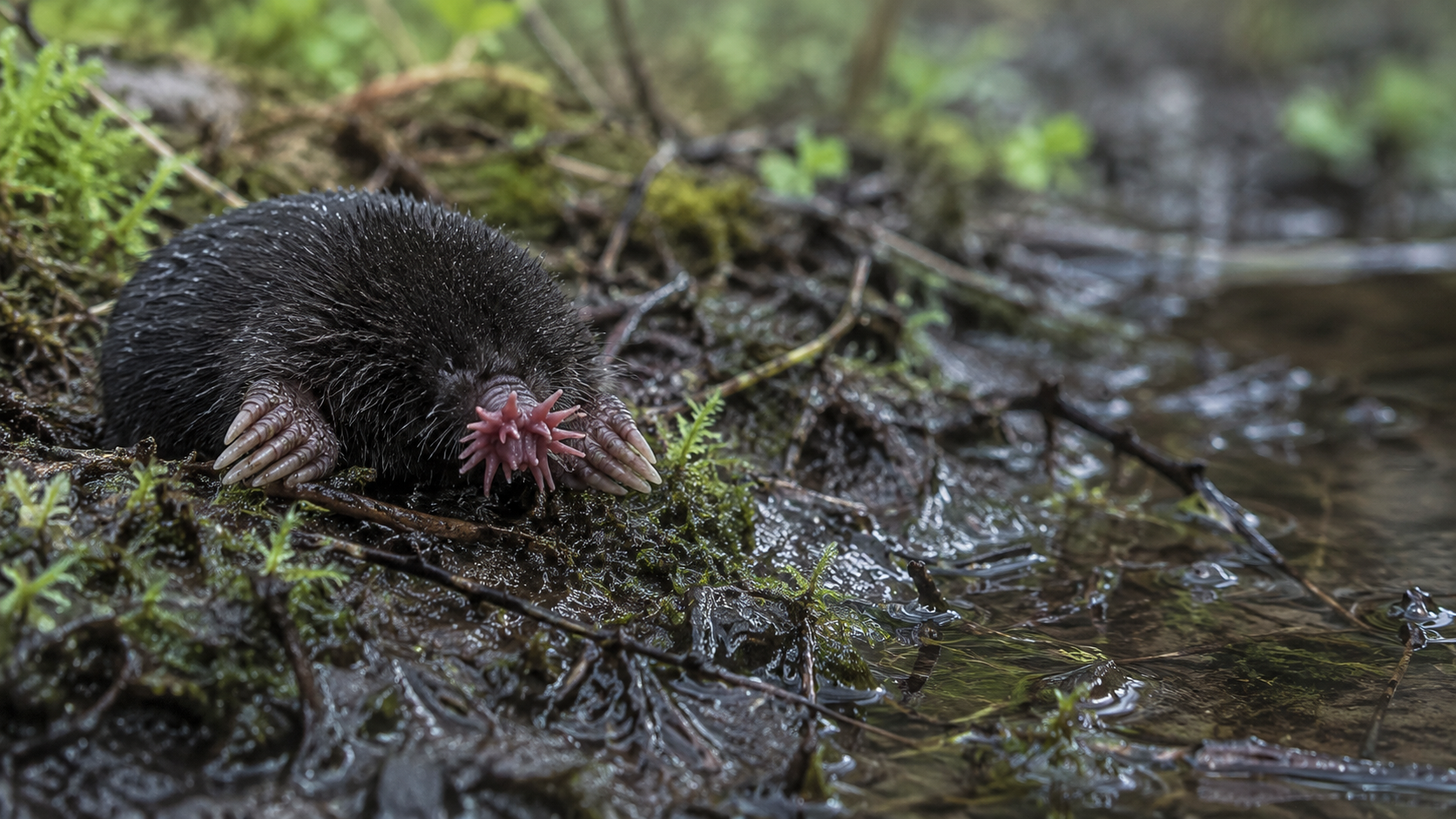
The star-nosed mole (Condylura cristata) is a small mammal that belongs to the family Talpidae. It is the only member of its genus and is found in North America, specifically in the eastern and central regions of Canada and the United States.
Quick Reference Table
| Characteristic | Description |
|---|---|
| Scientific Name | Condylura cristata |
| Common Name | Star-nosed mole |
| Family | Talpidae |
| Genus | Condylura |
| Conservation Status | Least Concern |
Taxonomy and Identification
The star-nosed mole is a member of the family Talpidae, which includes all moles. It is the only member of its genus, Condylura, and is closely related to the eastern mole (Scalopus aquaticus). The star-nosed mole is characterized by its distinctive star-shaped organ on its snout, which is made up of 22 fleshy tentacles. These tentacles are extremely sensitive and are used to detect seismic vibrations in the ground, allowing the mole to locate its prey.
Natural Habitat and Distribution
The star-nosed mole is found in the eastern and central regions of Canada and the United States, including the provinces of Quebec, Ontario, and Manitoba, and the states of New York, Pennsylvania, Ohio, Indiana, Illinois, Michigan, and Wisconsin. It inhabits a variety of habitats, including forests, grasslands, and wetlands, and is often found in areas with moist, loose soil.
Behaviour
The star-nosed mole is a solitary animal and is primarily active at night. It is a skilled digger and uses its powerful front legs and long claws to excavate complex networks of tunnels and burrows. The mole is also an excellent swimmer and has been known to swim long distances in search of food or shelter.
Diet
The star-nosed mole is a carnivorous mammal and feeds on a variety of invertebrates, including earthworms, insects, and snails. It also eats small vertebrates, such as mice and frogs, on occasion. The mole’s diet is rich in protein and is essential for its survival in the wild.
Habitat
The star-nosed mole is found in a variety of habitats, including forests, grasslands, and wetlands. It prefers areas with moist, loose soil that is easy to dig through. The mole is also found in areas with dense vegetation, such as forests and grasslands, where it can find shelter and protection from predators.
The star-nosed mole is a carnivorous mammal and feeds on a variety of invertebrates, including earthworms, insects, and snails. It also eats small vertebrates, such as mice and frogs, on occasion. The mole’s diet is rich in protein and is essential for its survival in the wild.
Daily Needs
In captivity, the star-nosed mole requires a diet rich in protein and low in fat. It needs a large enclosure with a deep layer of soil or sand, where it can dig and burrow. The enclosure should also have a source of water, such as a shallow dish or a water bowl. The mole’s environment should be kept at a temperature range of 60-80°F (15-27°C) and humidity level of 50-60%.
Warning Signs
If you are caring for a star-nosed mole in captivity, there are several warning signs to look out for. These include lethargy, loss of appetite, and changes in stool or urine output. If you notice any of these signs, it is essential to consult with a veterinarian experienced in caring for small mammals.
Responsible Care or Conservation
The star-nosed mole is listed as Least Concern on the IUCN Red List, but its populations are declining in some areas due to habitat loss and fragmentation. If you are interested in helping to conserve the star-nosed mole, you can support organizations that work to protect its habitat and reduce human impact on the environment.
What is the average lifespan of a star-nosed mole?
The average lifespan of a star-nosed mole in the wild is 2-3 years, although some individuals have been known to live up to 5 years in captivity.
How do star-nosed moles communicate?
Star-nosed moles communicate through a series of clicks, whistles, and body language. They also use their sense of smell to detect pheromones and other scent markings.
Are star-nosed moles social animals?
No, star-nosed moles are solitary animals and only come together during the breeding season.
What is the purpose of the star-shaped organ on the star-nosed mole’s snout?
The star-shaped organ on the star-nosed mole’s snout is made up of 22 fleshy tentacles that are extremely sensitive to seismic vibrations in the ground. This allows the mole to detect the movement of its prey and locate it in the dark.
Sources
- International Union for Conservation of Nature (IUCN). (2020). Condylura cristata.
- National Geographic. (2020). Star-Nosed Mole.
- Smithsonian’s National Zoo & Conservation Biology Institute. (2020). Star-Nosed Mole.
If you suspect that your star-nosed mole is sick or injured, it is essential to consult with a veterinarian experienced in caring for small mammals. They can provide you with advice on the best course of treatment and help you to ensure the health and well-being of your pet.
Life Cycle
The star-nosed mole’s life cycle is typical of many small mammals. They breed in the spring, with males engaging in a series of complex courtship behaviors to attract females. After a gestation period of approximately 40 days, females give birth to a litter of 2-5 young. The young moles are born blind and hairless, but develop quickly, opening their eyes after about 20 days and becoming independent after around 6 weeks. They reach reproductive maturity at around 6-8 months of age.
Communication and Senses
The star-nosed mole’s most distinctive feature, its star-shaped organ, is also its most important sensory organ. The 22 fleshy tentacles that make up this organ are extremely sensitive to seismic vibrations in the ground, allowing the mole to detect the movements of its prey. The mole also has a keen sense of smell, which it uses to locate food and detect potential threats. Its eyes are relatively small and not very sensitive, but it is able to detect light and dark.
Seasonal Variation
The star-nosed mole’s activity patterns vary throughout the year. During the spring and summer, they are active during the day and night, foraging for food and tending to their young. In the fall, they begin to prepare for the winter by storing fat reserves and reducing their activity levels. During the winter, they are relatively inactive, surviving on their stored fat reserves and only occasionally emerging to forage for food.
Ecological Relationships
The star-nosed mole plays an important role in its ecosystem, serving as both a predator and a prey species. It feeds on a variety of invertebrates, including earthworms, insects, and snails, helping to regulate their populations. It is also an important food source for many predators, including owls, hawks, and foxes.
Research
The star-nosed mole has been the subject of several research studies, particularly in the fields of ecology and conservation biology. Scientists have studied its behavior, population dynamics, and habitat use, in order to better understand its role in its ecosystem and to inform conservation efforts.
Responsible Enrichment
In captivity, star-nosed moles require a lot of space to move around and forage, as they would in the wild. They should be provided with a deep layer of soil or sand to dig in, and a variety of toys and objects to stimulate their sense of touch and smell. They also require a varied diet that includes a mix of live and frozen-thawed invertebrates.
Ethical and Legal Considerations
The star-nosed mole is not considered to be a threatened species, and is not protected by law in most jurisdictions. However, it is still important to treat them with respect and care, and to ensure that any capture or handling is done in a humane and responsible manner. In some areas, permits may be required to capture or keep star-nosed moles in captivity, and it is always best to check with local authorities before doing so.
## Reproduction and Development
The star-nosed mole has a unique reproductive strategy, with a breeding season that typically occurs in the spring and early summer. During this time, males will engage in intense competition for mates, and females will give birth to a litter of 2-5 young after a gestation period of approximately 45 days. The young moles are born blind and hairless, but develop quickly, and are weaned after about 4-6 weeks. The females will often have multiple litters in a single breeding season, and the young moles will disperse from their natal burrow after about 6-8 weeks.
## Social Structure and Burrowing Behavior
Star-nosed moles are typically solitary animals, only coming together during the breeding season. They are well-known for their extensive burrowing behavior, which they use to create complex networks of tunnels and chambers. These burrows can extend several meters underground and have multiple entrances and exits, allowing the moles to move quickly and easily through their underground environment. The burrows also provide protection from predators and extreme weather conditions.
## Adaptations and Specializations
The star-nosed mole has several adaptations that allow it to thrive in its underground environment. Its powerful front legs and long, sharp claws are well-suited for digging, and its small eyes are adapted to the low light conditions found in burrows. The mole’s sense of touch is also highly developed, and it uses its sensitive tentacles to detect seismic vibrations in the ground. This allows it to locate its prey, which consists mainly of earthworms and other invertebrates.
## Conservation and Management
While the star-nosed mole is currently listed as Least Concern on the IUCN Red List, its populations are often impacted by human activities such as habitat destruction and fragmentation. The mole’s burrowing behavior can also bring it into conflict with human activities such as agriculture and construction. As a result, conservation efforts are necessary to protect the mole and its habitat, and to promote coexistence with human activities.
## Cultural Significance
The star-nosed mole has a significant place in the cultural heritage of many indigenous communities in North America. In some cultures, the mole is considered a symbol of good luck and prosperity, while in others it is seen as a trickster figure. The mole’s unique appearance and behaviors have also made it a popular subject in art and literature.
## Research and Monitoring
Research on the star-nosed mole is ongoing, with scientists studying its behavior, ecology, and conservation biology. Monitoring programs are also in place to track the mole’s populations and habitat use, and to identify areas where conservation efforts are needed. This research and monitoring are essential for the effective conservation and management of the star-nosed mole and its habitat.