Opening Observation
At sunrise over a coastal cliff, a dark silhouette streaks past the sea‑foam, then vanishes in a blur of motion. That fleeting flash is often a peregrine falcon (Falco peregrinus) executing a hunting dive—known as a stoop—at speeds that can exceed 320 km/h (200 mph). This remarkable performance, coupled with a worldwide distribution, makes the species a focal point for both birdwatchers and conservationists.
Quick Reference
| Aspect | Detail |
|---|---|
| Scientific name | Falco peregrinus |
| Family | Falconidae |
| Average wingspan | 95–120 cm (37–47 in) |
| Weight | 0.7–1.5 kg (1.5–3.3 lb) |
| Global range | Every continent except Antarctica |
| Conservation status | Least Concern (IUCN) |
Classification
The peregrine belongs to the order Falconiformes, family Falconidae. Within the genus Falco, it is the type species, meaning the genus was defined around it. Subspecies are recognised across its range; the most widely cited are F. p. anatum (North America), F. p. tundrius (Arctic), and F. p. brookei (Southern Africa). Molecular studies (e.g., Fuchs et al., 2015) confirm that peregrines share a recent common ancestor with the saker falcon (F. cherrug) and the lanner falcon (F. biarmicus).
Physical Characteristics
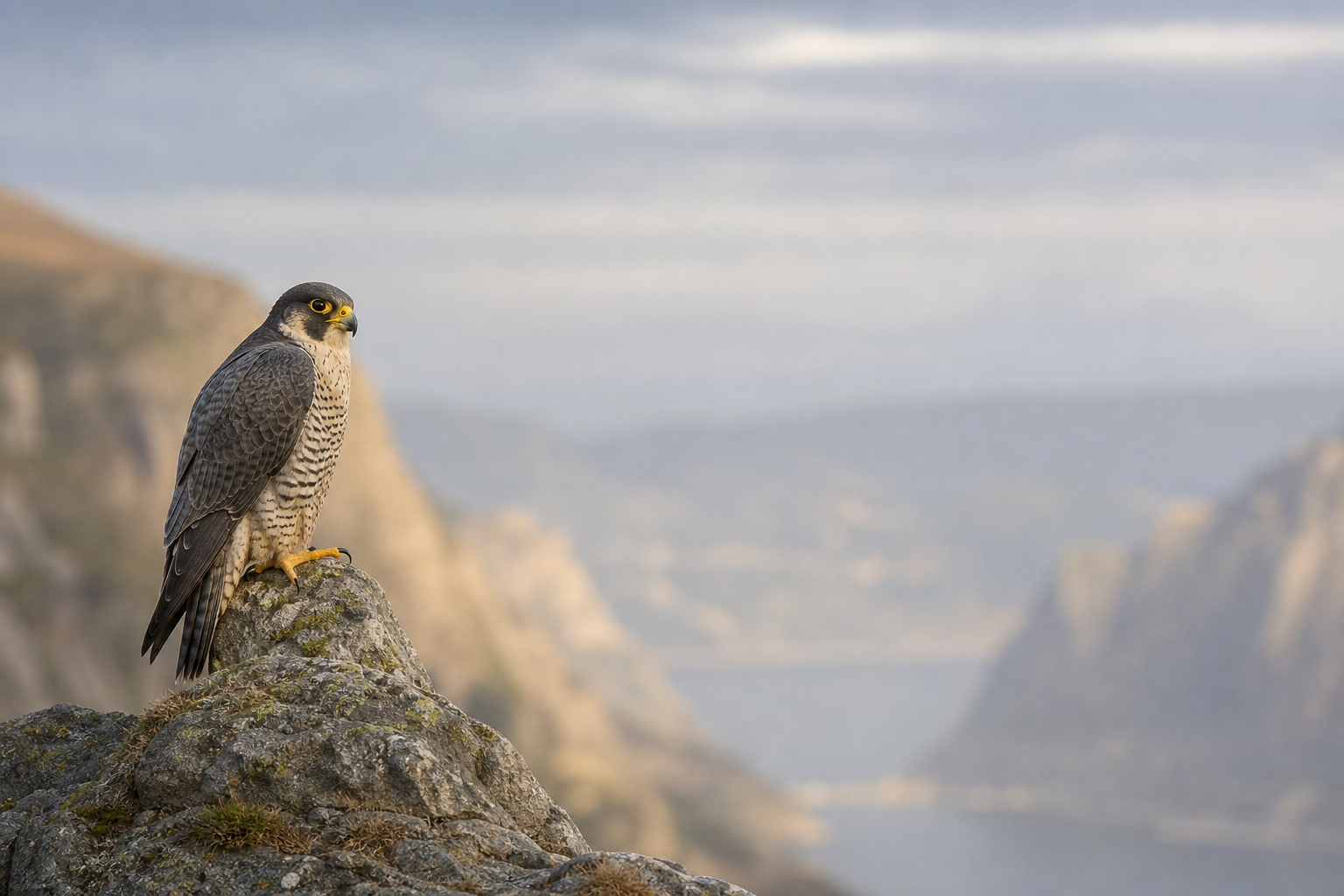
Adult peregrines are medium‑sized raptors, typically 34–58 cm (13–23 in) in body length. Their plumage is a striking contrast: a slate‑gray back, barred white underparts, and a black “moustache” that runs from the base of the beak to the throat. Females are larger and slightly heavier than males, a pattern known as reverse sexual dimorphism, which influences prey selection.
Key adaptations for high‑speed flight include a tapered, pointed wing shape that reduces drag, and a robust, hooked beak designed to shear flesh. The eyes are exceptionally large relative to skull size, providing acute binocular vision; a single, central fovea grants a visual acuity estimated at 2–3 times that of humans. Musculature in the chest is highly developed, allowing rapid wingbeats during the initial acceleration phase of a stoop.
Molting occurs once a year, usually after the breeding season. Unlike many raptors, peregrines replace feathers in a staggered fashion, ensuring they retain flight capability throughout the process.
Behaviour
Peregrines are solitary hunters but display strong territoriality during the breeding season. Territories can span several square kilometres, especially in open tundra or coastal environments where prey is abundant. Males perform aerial displays—high‑altitude soaring followed by rapid dives—to attract mates and to advertise the quality of their hunting grounds.
The hallmark behaviour is the stoop. From a perch or a high glide, the bird tucks its wings, assumes a streamlined posture, and dives toward a target, often a medium‑sized bird in mid‑flight. The acceleration is powered by gravity; the falcon’s muscles and aerodynamic shape simply control the trajectory. Once the prey is captured, the falcon uses its talons to seize and its beak to deliver a killing bite to the neck.
Outside of hunting, peregrines spend much of the day perched on high points—cliffs, skyscraper ledges, or telephone towers—where they can scan the horizon for movement. They are known to be tolerant of human structures, a trait that has facilitated their urban resurgence in many cities.
Habitat and Suitable Environment
The species occupies a remarkably broad range of habitats, from arctic tundra and alpine cliffs to desert canyons and metropolitan rooftops. What unites these environments is the presence of high perches and a reliable supply of avian prey. In North America, the western population favors the rugged cliffs of the Cascade and Sierra Nevada ranges, while the eastern population often nests on tall buildings in cities such as New York and Chicago.
Climatic tolerance is extensive; peregrines thrive in temperatures from –30 °C (–22 °F) in the Arctic to over 35 °C (95 °F) in desert regions. Their adaptability is linked to flexible nesting choices: natural ledges, abandoned nests of other birds, and artificial platforms installed by conservation programs.
Because they rely on sight rather than sound to locate prey, habitats with clear, unobstructed air are preferred. Foggy or heavily polluted areas can reduce hunting efficiency, although peregrines have been observed adjusting flight paths to compensate.
In the next sections we will explore diet, daily needs, warning signs, and the ongoing conservation efforts that have turned a once‑endangered bird into a global success story.
Diet and Hunting Technique
In the wild, the peregrine (Falco peregrinus) subsists almost entirely on other birds. Typical prey includes pigeons, starlings, sandpipers, and even waterfowl the size of a duck. The falcon’s signature hunting method—called a stoop—involves a high‑altitude dive that can exceed 320 km/h (200 mph). This speed, combined with keen eyesight (up to eight times sharper than human vision), allows the bird to strike prey mid‑air with a precision that leaves the victim stunned or dead within milliseconds.
When prey is too large to be taken in a single strike, the falcon may seize it with its talons and carry it back to a perch or nest. In urban settings, where pigeons are abundant, peregrines have adapted to hunt from skyscraper ledges that mimic cliff faces.
Daily Needs: Space, Rest, and Enrichment
Adult peregrines require a territory that provides both hunting grounds and safe roosting sites. In natural habitats this means a stretch of open sky over cliffs, coastlines, or open tundra, typically ranging from 10 to 30 km². In captivity, a flight enclosure of at least 12 × 6 × 4 m (length × width × height) is recommended, with perches that simulate natural ledges and a water source for bathing.
Rest periods are short but frequent; a peregrine may nap for 10‑15 minutes several times a day, often on a high perch where it can scan the horizon. Mental stimulation is crucial: rotating perches, introducing varied prey items, and providing visual stimuli (e.g., moving silhouettes) help prevent stereotypic behaviors.
Warning Signs and Health Indicators
Because peregrines are high‑performance predators, subtle changes can signal serious issues. Caretakers should watch for:
- Reduced hunting activity: A sudden decline in successful stoops may indicate injury or illness.
- Feather damage: Broken or ragged primary feathers compromise aerodynamics and should be inspected promptly.
- Respiratory sounds: Wheezing or persistent coughing can be a sign of fungal infection (e.g., aspergillosis).
- Weight loss: A loss of more than 5 % body mass within two weeks warrants veterinary evaluation.
- Abnormal droppings: Diarrhea or blood in feces may indicate gastrointestinal parasites or trauma.
Any of these signs should trigger a consultation with an avian veterinarian experienced in raptor medicine.
Responsible Care and Conservation
Globally, the peregrine falcon is a conservation success story. After near‑extinction in the mid‑20th century due to DDT, coordinated breeding and re‑introduction programs restored populations across North America, Europe, and Asia. Today, the species is listed as “Least Concern” by the IUCN, but localized threats persist.
Key responsibilities for owners, wildlife rehabilitators, and citizen scientists include:
- Minimising pesticide exposure: Avoid feeding prey that may have accumulated organochlorines or neonicotinoids.
- Maintaining safe flight corridors: In urban areas, support the preservation of tall structures that serve as nesting sites.
- Monitoring population trends: Contribute observations to databases such as eBird or the Global Raptor Impact Network.
- Supporting research: Donate to organizations like the Peregrine Fund, which funds habitat protection and scientific studies.
When keeping a peregrine in captivity for education or rehabilitation, it is essential to obtain the appropriate permits and to follow the legal standards set by the Convention on International Trade in Endangered Species (CITES) and local wildlife agencies.
Frequently Asked Questions
How fast can a peregrine falcon really dive?
High‑speed telemetry studies have recorded stoops reaching 389 km/h (242 mph) in ideal conditions, making it the fastest member of the animal kingdom.
Do peregrine falcons mate for life?
Pairs typically remain together for several breeding seasons, often re‑using the same nest site. However, if a mate dies or fails to breed, a new partnership may form.
Can a peregrine be kept as a pet?
In most jurisdictions, private ownership is restricted to licensed falconers or accredited institutions. The bird’s specialized diet, space requirements, and legal protections make it unsuitable for casual pet ownership.
What is the primary cause of mortality in young peregrines?
Nestling mortality is often linked to food scarcity, predation by larger raptors, and exposure to pesticides that weaken immune function.
How does climate change affect peregrine populations?
Rising temperatures shift the distribution of prey species and can alter migration timing, potentially creating mismatches between peak prey abundance and breeding periods.
Key Facts at a Glance
| Attribute | Detail |
|---|---|
| Scientific name | Falco peregrinus |
| Average wingspan | 95–120 cm (37–47 in) |
| Maximum recorded dive speed | 389 km/h (242 mph) |
| Typical lifespan | 13 years in the wild; up to 20 years in captivity |
| Conservation status | Least Concern (IUCN) |
References
- BirdLife International. “Falco peregrinus”. IUCN Red List of Threatened Species, 2023.
- The Peregrine Fund. “Peregrine Falcon Conservation”. https://www.peregrinefund.org.
- National Geographic. “The Fastest Animals on Earth”. 2022.
- American Association of Avian Veterinarians. “Raptor Health Guidelines”. 2021.
- eBird. “Global Distribution Maps for Falco peregrinus”. 2024.
Note: This guide provides general information. For any health concerns or legal questions regarding peregrine falcons, consult a qualified avian veterinarian or the appropriate wildlife authority.