
Introduction
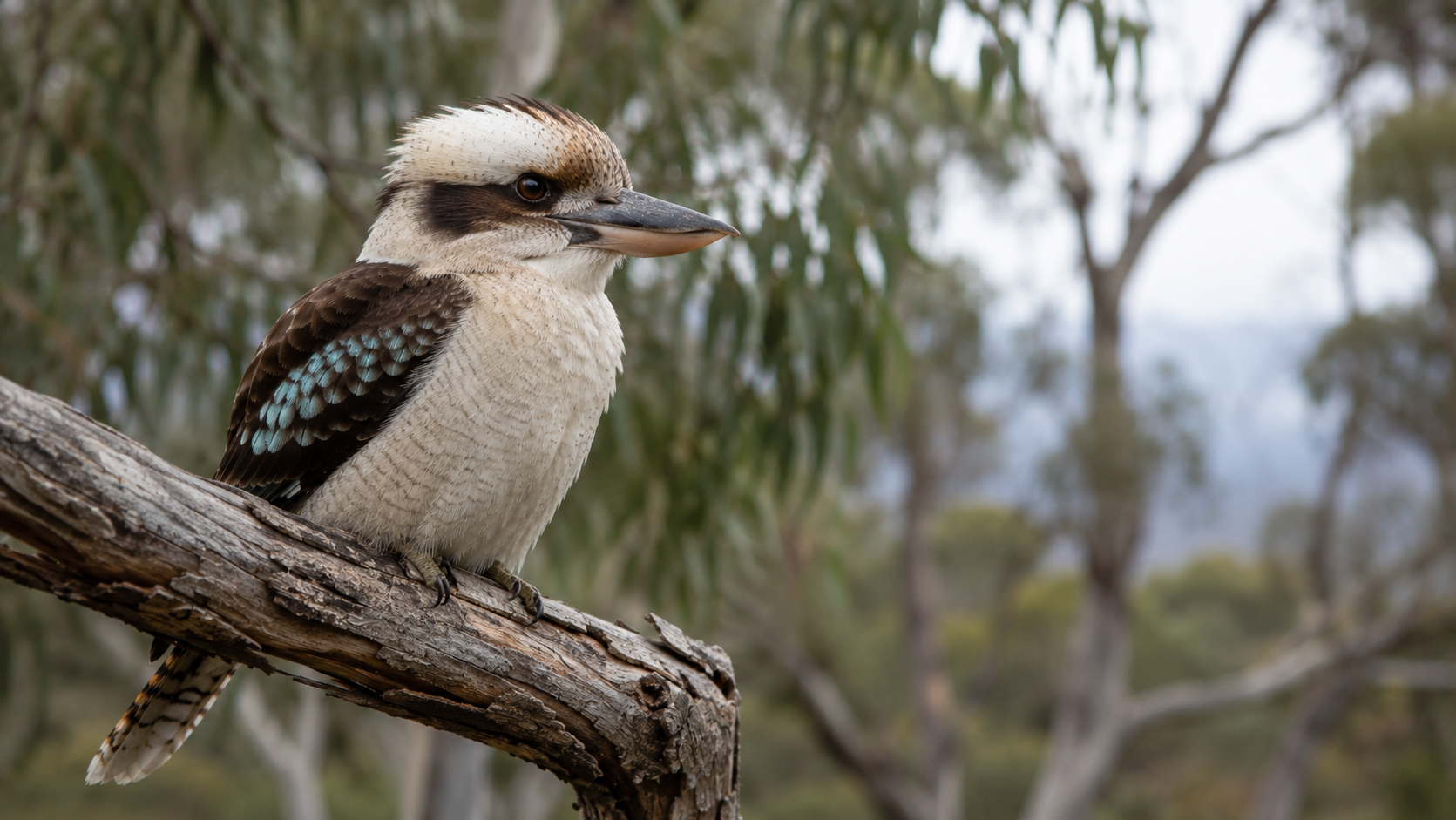
The Kookaburra is a large kingfisher native to Australia, known for its distinctive laugh-like call and bold, curious nature.
Classification and Evolution
The Kookaburra belongs to the family Alcedinidae and is classified into four species: the Laughing Kookaburra (Dacelo novaeguineae), the Blue-winged Kookaburra (Dacelo leachii), the Rufous-bellied Kookaburra (Dacelo gaudichaud), and the Spangled Kookaburra (Dacelo tyro).
Physical Characteristics
Kookaburras are medium to large-sized birds, measuring between 37-45 cm in length and weighing between 200-400 grams. They have a stout body, a large head, and a long, pointed bill. Their plumage is brown or grey, with a distinctive white or blue patch on the wings.
| Species | Length (cm) | Weight (g) | Wingspan (cm) |
|---|---|---|---|
| Laughing Kookaburra | 37-42 | 200-300 | 50-60 |
| Blue-winged Kookaburra | 38-43 | 250-350 | 55-65 |
| Rufous-bellied Kookaburra | 35-40 | 180-280 | 45-55 |
| Spangled Kookaburra | 40-45 | 300-400 | 60-70 |
Habitat and Distribution
Kookaburras are found in eastern and southern Australia, from the tropical north to the temperate south. They inhabit a variety of environments, including forests, woodlands, and urban areas.
Diet and Foraging
Kookaburras are carnivorous birds that feed on a wide range of prey, including insects, small reptiles, amphibians, and mammals. They are known for their bold and curious nature, and will often approach humans in search of food.
Behavior and Social Structure
Kookaburras are social birds that live in small family groups. They are known for their loud, laugh-like call, which is often used for communication and territorial defense.
Conservation Status
Kookaburras are not considered to be a threatened species, although their populations are declining in some areas due to habitat loss and fragmentation.
Interesting Facts
Kookaburras are known for their unique call, which sounds like a loud, cackling laugh. They are also known for their bold and curious nature, and will often approach humans in search of food.
What is the average lifespan of a Kookaburra?
The average lifespan of a Kookaburra is around 10-15 years in the wild, although some individuals have been known to live up to 20 years.
What is the typical diet of a Kookaburra?
Kookaburras are carnivorous birds that feed on a wide range of prey, including insects, small reptiles, amphibians, and mammals.
Are Kookaburras social birds?
Yes, Kookaburras are social birds that live in small family groups.
What is the conservation status of Kookaburras?
Kookaburras are not considered to be a threatened species, although their populations are declining in some areas due to habitat loss and fragmentation.
- Australian Museum. (n.d.). Kookaburra. Retrieved from https://australian.museum/learn/animals/birds/kookaburra
- BirdLife Australia. (n.d.). Kookaburra. Retrieved from https://www.birdlife.org.au/birds/australian-birds/kookaburra
- CSIRO. (n.d.). Kookaburra. Retrieved from https://www.csiro.au/en/Research/Environment/Biodiversity/Kookaburra
Please note that the information provided is for educational purposes only and should not be used for veterinary or conservation advice. If you have any concerns about the health or well-being of a Kookaburra, please consult a qualified veterinarian or wildlife expert.
Life Cycle and Development
Kookaburras are monogamous birds, with pairs forming during the breeding season. The female lays 2-4 eggs in a nest made of twigs, grasses, and other plant material, which is typically located in a tree cavity or rock crevice. Both parents take turns incubating the eggs for about 24-26 days, and the chicks hatch blind and helpless. The parents feed and care for the chicks, which leave the nest after about 30-40 days. The young birds are dependent on their parents for food and protection for several weeks after fledging.
During this time, the parents teach the young birds important survival skills, such as foraging and predator avoidance. The young birds begin to venture out on their own after about 6-8 weeks, but may still return to the nest for food and shelter. Kookaburras can live for up to 20 years in the wild, although the average lifespan is around 10-15 years.
Communication and Senses
Kookaburras are known for their distinctive laugh-like call, which is often described as a loud, cackling sound. This call is used for a variety of purposes, including contact between mates, warning other birds of potential threats, and advertising territory. Kookaburras also use a range of other vocalizations, including chirps, whistles, and grunts, to communicate with each other.
In addition to their vocalizations, kookaburras also use visual displays to communicate. They will often perch in a prominent location, such as a tree branch or power line, and display their brightly colored plumage to attract a mate or deter a rival. Kookaburras also have excellent eyesight, and use their sharp, pointed bills to catch prey in mid-air.
Seasonal Variation
Kookaburras are adapted to the changing seasons in Australia, and their behavior and physiology vary accordingly. During the breeding season, which typically occurs in the spring and summer months, kookaburras are more vocal and active, and spend more time foraging for food to feed their young.
In the winter months, kookaburras are less active, and may go for extended periods without food or water. They will often roost together in large groups, sharing body heat to conserve energy. Kookaburras also have a unique physiological adaptation that allows them to survive for extended periods without water, by producing highly concentrated urine and dry dung.
Ecological Relationships
Kookaburras play an important role in their ecosystems, serving as both predators and prey. They feed on a wide range of invertebrates and small vertebrates, helping to regulate populations and maintain ecosystem balance. Kookaburras are also an important food source for other predators, such as snakes, goannas, and birds of prey.
In addition to their role in the food chain, kookaburras also play a role in seed dispersal and forest regeneration. They eat fruit and then deposit the seeds in new locations, often in nutrient-rich soil, allowing the seeds to germinate and grow into new plants.
Research and Conservation Efforts
Kookaburras are an important subject of research, particularly in the fields of ecology and conservation biology. Scientists are studying the behavior, physiology, and ecology of kookaburras to better understand their role in their ecosystems and to develop effective conservation strategies.
Conservation efforts are also underway to protect kookaburra populations and habitats. The Australian government has listed the Laughing Kookaburra as a species of “least concern,” but the Blue-winged Kookaburra is listed as “vulnerable” due to habitat loss and fragmentation. Conservation organizations are working to protect and restore habitats, as well as to educate the public about the importance of kookaburra conservation.
Responsible Enrichment and Ethical Considerations
Kookaburras are popular birds in captivity, and are often kept in zoos and wildlife parks. However, keeping kookaburras in captivity can be challenging, and requires specialized care and housing. Kookaburras have complex social and spatial needs, and require large enclosures with plenty of space to fly and forage.
In addition to providing adequate housing and care, it is also important to consider the ethical implications of keeping kookaburras in captivity. Kookaburras are wild animals, and should be treated with respect and dignity. They should not be kept in captivity for entertainment or profit, but rather for education, conservation, and research purposes.
Adaptation to Human-Modified Environments
Kookaburras have demonstrated an impressive ability to adapt to human-modified environments, thriving in urban and suburban areas. They can be found in parks, gardens, and even backyards, where they take advantage of food sources such as insects, worms, and small reptiles. In some cases, they have even learned to exploit human-provided food, such as scraps and pet food.
Their adaptability is likely due to their intelligence and curious nature, which allows them to quickly learn and adjust to new environments. Additionally, their bold and fearless attitude enables them to coexist with humans, often approaching people in search of food or interacting with them in a non-aggressive manner.
However, this adaptability also raises concerns about the impact of human activity on Kookaburra populations. For example, the use of pesticides and other chemicals in urban areas can reduce the availability of food for Kookaburras, while the destruction of natural habitats can lead to fragmentation and isolation of populations.
Ecological Role in Australian Ecosystems
As apex predators, Kookaburras play a crucial role in maintaining the balance of Australian ecosystems. They prey on a wide range of invertebrates and small vertebrates, helping to regulate populations and maintain the structure of food webs.
In particular, Kookaburras are known to prey on snakes, including venomous species such as the eastern brown snake and the tiger snake. This helps to protect other animals, including humans, from the threat of snake bites.
Additionally, Kookaburras contribute to seed dispersal and forest regeneration through their foraging activities. They help to spread seeds by consuming fruit and then depositing the seeds in new locations, often in nutrient-rich environments.
Threats and Challenges in a Changing Environment
Despite their adaptability, Kookaburras face a range of threats and challenges in a changing environment. Climate change, for example, is altering the availability of food resources and shifting the distribution of prey species.
Habitat destruction and fragmentation, driven by urbanization and land clearing, are also major concerns. As natural habitats are destroyed or degraded, Kookaburra populations become isolated and fragmented, reducing their ability to adapt and respond to environmental changes.
Furthermore, the introduction of invasive species, such as cats and foxes, has led to increased predation pressure on Kookaburra populations. These predators can have a significant impact on Kookaburra numbers, particularly in areas where their habitats overlap.
Overall, while Kookaburras are highly adaptable birds, they still face significant challenges in a changing environment. Conservation efforts, such as habitat restoration and protection, are essential to ensuring the long-term survival of these iconic birds.


