
Natural History
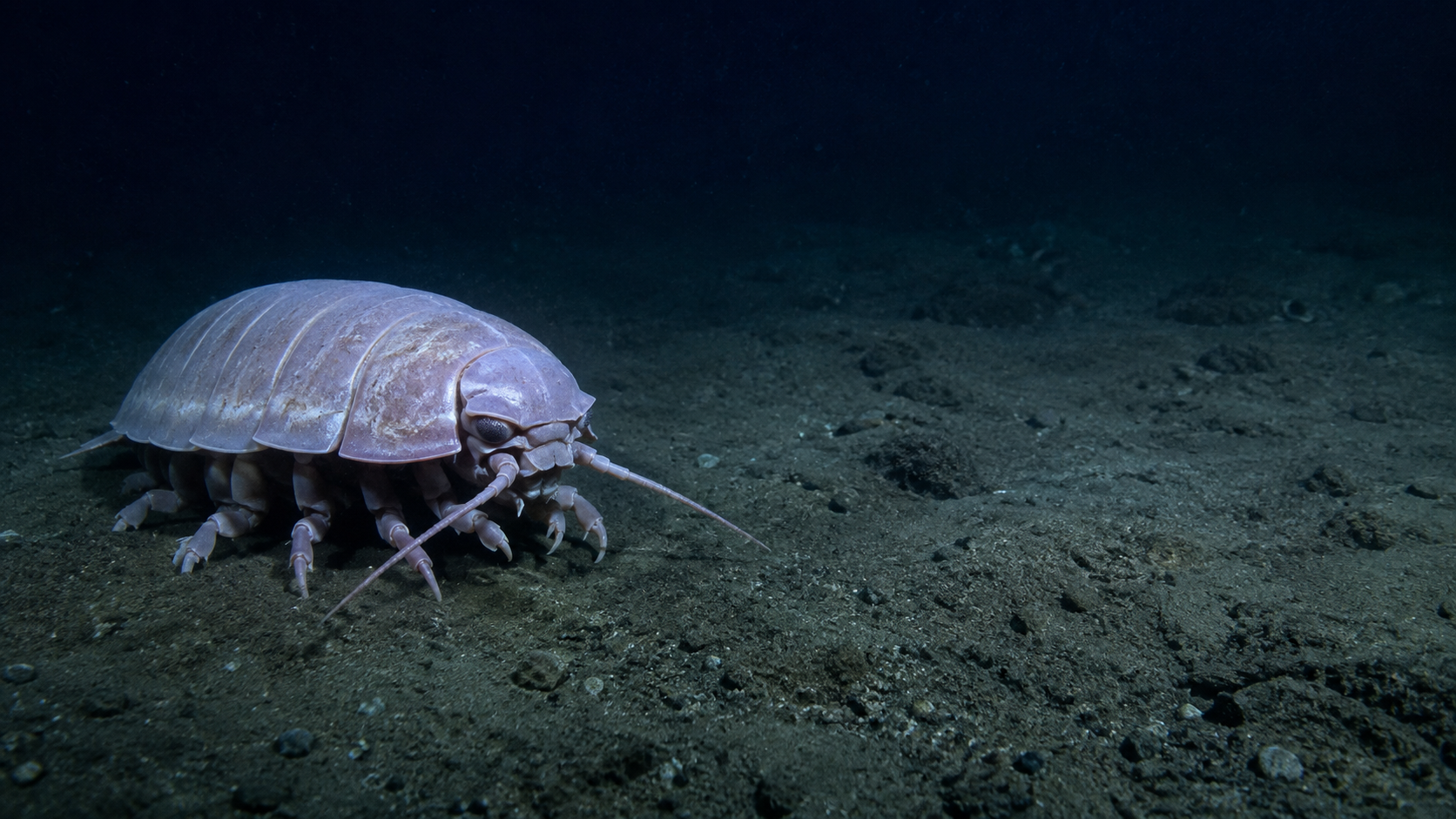
The Giant Isopod (Bathynomus giganteus) is a deep-sea crustacean that inhabits the oceans around the world, typically between 200-7,000 meters in depth. It has a pillbug-like appearance, with a rounded body and seven pairs of legs.
Physical Characteristics
Giant Isopods can grow up to 76 cm in length and weigh up to 4 kg, making them one of the largest isopod species in the world. They have a hard, calcified exoskeleton that is brown or gray in color, and their bodies are divided into three main sections: the cephalon (head), thorax (body), and abdomen (tail).
Diet and Foraging
Giant Isopods are scavengers and feed on the carcasses of other animals, such as fish, whales, and other invertebrates. They have also been known to feed on algae and other plant material. They use their powerful claws and mouthparts to tear flesh and crush bone.
Reproduction and Life Cycle
Little is known about the reproductive habits of Giant Isopods, but it is believed that they mate in the spring and summer months. Females lay eggs that hatch into larvae, which go through several stages of development before reaching adulthood.
Conservation Status
Giant Isopods are not considered to be a threatened species, but their populations are often affected by deep-sea fishing and habitat destruction. They are also vulnerable to climate change, which can alter the distribution of their food sources and habitats.
| Characteristic | Description |
|---|---|
| Length | Up to 76 cm |
| Weight | Up to 4 kg |
| Habitat | Deep-sea environments, 200-7,000 meters in depth |
| Diet | Scavenger, feeds on carcasses and plant material |
| Reproduction | Mates in spring and summer, females lay eggs that hatch into larvae |
Safety Precautions
While Giant Isopods are not typically aggressive towards humans, they can inflict serious injury with their powerful claws. It is essential to exercise caution when handling or approaching these animals.
Observation and Study
Giant Isopods are often studied in deep-sea submersibles or remotely operated vehicles (ROVs). Scientists use these tools to observe their behavior, habitat, and population dynamics.
What is the average lifespan of a Giant Isopod?
Little is known about the lifespan of Giant Isopods, but it is believed to be several years.
Are Giant Isopods edible?
No, Giant Isopods are not considered edible and are not typically consumed by humans.
Can Giant Isopods be kept as pets?
No, Giant Isopods are not suitable for captivity and are not typically kept as pets.
What is the largest recorded size of a Giant Isopod?
The largest recorded Giant Isopod was 76 cm in length and weighed 4 kg.
- National Oceanic and Atmospheric Administration (NOAA). (2022). Giant Isopod.
- Smithsonian Institution. (2022). Giant Isopod.
- World Register of Marine Species. (2022). Bathynomus giganteus.
Responsible Use Notice: The information provided in this article is for educational purposes only and should not be used for commercial or personal gain. Giant Isopods are wild animals that should be treated with respect and caution. It is essential to prioritize their welfare and conservation.
Communication and Senses
Giant Isopods have a unique way of communicating with each other through a series of chemical signals, known as pheromones. These signals are released into the water and can be detected by other Giant Isopods, allowing them to convey information about food, potential mates, and predators. In addition to pheromones, Giant Isopods also use body language to communicate, such as raising their claws or vibrating their bodies to signal aggression or courtship.
In terms of senses, Giant Isopods have poor eyesight, but they are highly sensitive to touch and smell. They have a pair of antennae-like structures called antennules that are covered in sensory receptors, which allow them to detect vibrations and chemicals in the water. They also have a highly developed sense of smell, which they use to locate food and detect predators.
Seasonal Variation
Giant Isopods are found in deep-sea environments around the world, where the temperature and pressure are relatively constant. However, there are some seasonal variations in their behavior and physiology. For example, during the spring and summer months, Giant Isopods are more active and tend to move closer to the surface in search of food. During the winter months, they tend to move deeper and enter a state of dormancy, known as “torpor,” to conserve energy.
In addition, Giant Isopods have been found to have a unique physiological adaptation to the changing seasons. They have a specialized organ called a “hepatopancreas” that allows them to store energy-rich compounds during times of plenty, which they can then use during times of scarcity. This adaptation allows them to survive in environments where food is scarce and unpredictable.
Ecological Relationships
Giant Isopods play a crucial role in the deep-sea ecosystem, serving as both predators and prey for other animals. They are an important food source for many deep-sea fish and invertebrates, such as anglerfish and sea stars. In turn, Giant Isopods feed on the carcasses of other animals, helping to recycle nutrients and energy through the ecosystem.
Giant Isopods also have a symbiotic relationship with certain species of bacteria that live in their gut. These bacteria help to break down the complex organic matter that Giant Isopods eat, allowing them to extract nutrients that would otherwise be unavailable. In return, the bacteria receive a safe and stable environment in which to live.
Research and Study
Giant Isopods are an important subject of research in the fields of marine biology and ecology. Scientists are interested in studying their behavior, physiology, and ecology in order to better understand the deep-sea environment and the animals that live there.
One area of research that is currently being explored is the use of Giant Isopods as a model organism for studying the effects of climate change on deep-sea ecosystems. Because Giant Isopods are found in deep-sea environments around the world, they can provide a unique perspective on the impacts of climate change on these ecosystems.
Responsible Enrichment and Ethical Considerations
Giant Isopods are often kept in aquariums and research institutions, where they are used for educational and research purposes. However, it is essential to ensure that these animals are treated with respect and care, and that their welfare is prioritized.
In terms of enrichment, Giant Isopods require a stimulating environment that provides them with opportunities for exploration and foraging. This can include providing them with a varied diet, as well as creating a complex environment with rocks, crevices, and other hiding places.
In terms of ethics, it is essential to consider the impact of capturing and keeping Giant Isopods on their populations in the wild. It is also important to ensure that these animals are not subjected to unnecessary stress or harm, and that their welfare is prioritized at all times.
Developmental Stages and Growth Patterns
The developmental stages of Giant Isopods are not well understood, but research suggests that they undergo a complex process of growth and molting. After hatching from eggs, the larvae go through several stages of development, including a nauplius stage, a zoea stage, and a megalopa stage. During these stages, the larvae undergo significant changes in their body shape and structure, eventually developing into juvenile isopods that resemble small versions of adults.
As Giant Isopods grow, they undergo a process called molting, in which they shed their exoskeleton to accommodate increasing size. This process can be repeated several times throughout their lives, allowing them to grow and develop into the massive creatures that have been observed in the deep sea.
Ecological Role and Importance
Giant Isopods play a crucial role in the deep-sea ecosystem, serving as both scavengers and prey for other animals. As scavengers, they help to clean up carcasses and other organic matter that sinks to the seafloor, preventing the buildup of decaying material and maintaining the balance of the ecosystem. They also serve as an important food source for other deep-sea animals, such as fish and other invertebrates.
In addition to their ecological role, Giant Isopods have also been found to have a significant impact on the deep-sea environment. Their burrowing activities can help to mix and aerate the sediment, improving the quality of the habitat for other animals. They also contribute to the process of bioturbation, which helps to distribute nutrients and organic matter throughout the ecosystem.
Captivity and Research
Giant Isopods have been kept in captivity for research purposes, providing scientists with a unique opportunity to study these fascinating creatures up close. In captivity, Giant Isopods have been observed to be relatively long-lived, with some individuals living for several years. They have also been found to be relatively low-maintenance animals, requiring a diet of frozen meat and a tank with a deep layer of sediment.
Research on Giant Isopods has focused on a variety of topics, including their ecology, behavior, and physiology. Scientists have used a range of techniques, including submersibles and remotely operated vehicles (ROVs), to study Giant Isopods in their natural habitat. In captivity, researchers have used a range of methods, including experiments and observations, to study the behavior and physiology of these animals.
Threats and Vulnerabilities
Giant Isopods are vulnerable to a range of threats, including habitat destruction, climate change, and overfishing. The deep-sea environment is a fragile and poorly understood ecosystem, and human activities such as bottom trawling and mining can have a significant impact on the habitat and the animals that live there.
Climate change is also a major threat to Giant Isopods, as it can alter the distribution and abundance of their food sources and affect the quality of their habitat. In addition, the deep sea is a relatively unregulated environment, and there is a risk that Giant Isopods could be targeted by fisheries or other human activities.
Conservation Efforts
Conservation efforts for Giant Isopods are limited, but there are a range of initiatives underway to protect the deep-sea environment and the animals that live there. These include the establishment of marine protected areas, which can provide a safe haven for Giant Isopods and other deep-sea animals.
In addition, there are a range of research initiatives underway to study the ecology and behavior of Giant Isopods, and to develop effective conservation strategies. These include the use of submersibles and ROVs to study Giant Isopods in their natural habitat, and the development of captive breeding programs to help maintain healthy populations of these animals.


