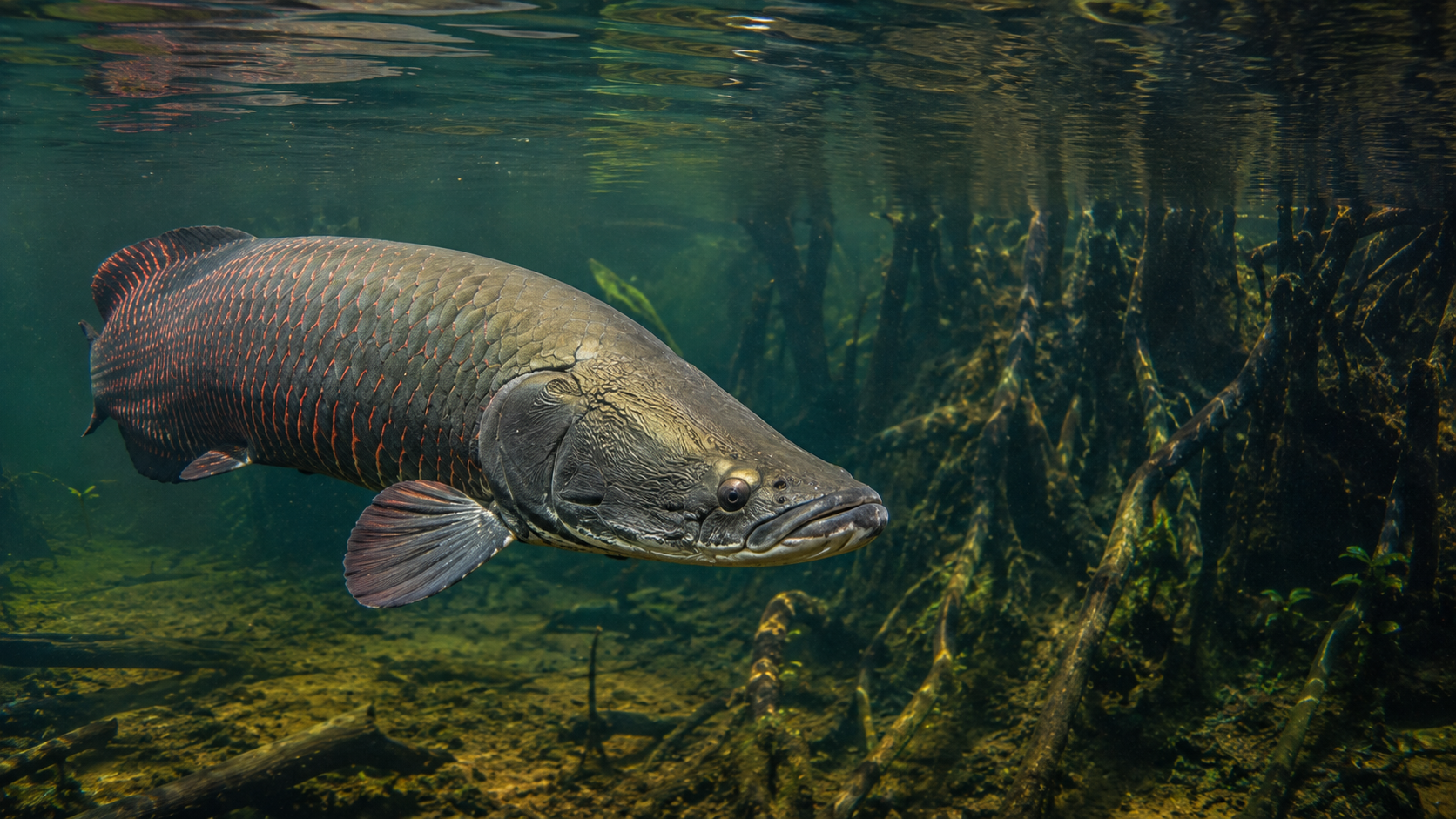
Arapaima
The Arapaima is a large freshwater fish native to the Amazon and Orinoco river basins in South America. It is a wild species that belongs to the family Arapaimidae.
Classification and Evolution
The Arapaima is classified as Arapaima gigas and is a member of the order Osteoglossiformes. Fossil records indicate that the Arapaima has remained largely unchanged for millions of years, with some fossils dating back to the Miocene epoch.
Natural Habitat and Distribution
Arapaimas are found in the freshwater rivers and lakes of the Amazon and Orinoco river basins, including countries such as Brazil, Peru, and Colombia. They inhabit slow-moving waters with abundant vegetation and submerged logs.
Physical Characteristics
Arapaimas can grow up to 3 meters (10 feet) in length and weigh up to 200 kilograms (440 pounds), making them one of the largest freshwater fish in the world. They have a broad, flat head, a long, slender body, and a distinctive mouth with many small teeth.
| Characteristic | Description |
|---|---|
| Scientific Name | Arapaima gigas |
| Family | Arapaimidae |
| Order | Osteoglossiformes |
| Length | Up to 3 meters (10 feet) |
| Weight | Up to 200 kilograms (440 pounds) |
| Habitat | Freshwater rivers and lakes |
| Distribution | Amazon and Orinoco river basins |
Diet and Feeding Habits
Arapaimas are carnivores and feed on a variety of prey, including fish, crustaceans, and insects. They are air-breathing fish and can survive out of water for short periods of time, allowing them to feed on terrestrial animals that venture too close to the water’s edge.
Conservation Status
The Arapaima is listed as Vulnerable on the IUCN Red List due to overfishing and habitat loss. Conservation efforts are underway to protect the species and its habitat.
Public Safety and Responsible Observation
Arapaimas are wild animals and should be treated with caution. They are not typically aggressive towards humans, but can inflict serious injury with their sharp teeth and powerful jaws. Observers should keep a safe distance and avoid feeding or touching the fish.
What is the average lifespan of an Arapaima?
The average lifespan of an Arapaima is around 15-20 years in the wild.
How do Arapaimas breathe?
Arapaimas are air-breathing fish and can absorb oxygen from both water and air.
Are Arapaimas endangered?
The Arapaima is listed as Vulnerable on the IUCN Red List due to overfishing and habitat loss.
Can Arapaimas be kept as pets?
No, Arapaimas are wild animals and are not suitable for captivity. They require specialized care and housing that is not feasible in a home environment.
- World Wildlife Fund. (2022). Arapaima.
- FishBase. (2022). Arapaima gigas.
- International Union for Conservation of Nature. (2022). Arapaima gigas.
Remember to respect wildlife and their habitats. Never attempt to touch, feed, or capture wild animals, and support conservation efforts to protect species like the Arapaima.
Life Cycle and Reproduction
Arapaimas have a unique life cycle, with a complex reproductive process. They are air-breathing fish, which means they can absorb oxygen from both water and air. This adaptation allows them to survive in low-oxygen environments, such as stagnant pools and flooded forests. Arapaimas can live up to 20 years in the wild, although their average lifespan is around 10-15 years.
During the breeding season, which typically occurs during the rainy season, Arapaimas migrate to shallow, flooded areas with abundant vegetation. Males engage in a complex courtship ritual, involving loud drumming sounds and visual displays, to attract females. Once a pair has formed, they build a nest using vegetation and mud, which can be up to 2 meters (6.6 feet) in diameter.
Female Arapaimas lay around 50,000 eggs, which are then fertilized by the male. The eggs hatch after 24-48 hours, and the larvae drift in the water column, feeding on plankton and small invertebrates. After several weeks, the larvae settle on the bottom and begin to feed on small fish and invertebrates.
Communication and Senses
Arapaimas have a range of communication methods, including vocalizations, visual displays, and even electrical signals. They use a unique organ, called the “drumming muscle,” to produce loud drumming sounds, which can be heard for miles. These sounds are used for communication, mating, and territorial defense.
Arapaimas also have a highly developed sense of smell, which they use to detect prey and navigate their environment. Their eyes are relatively small, but they have a reflective layer called the “tapetum lucidum,” which helps them to see in low light conditions.
In addition to their senses, Arapaimas have a unique ability to detect electrical signals, which they use to navigate and find prey. This is made possible by specialized electroreceptors called “ampullae of Lorenzini,” which are found on their snout and around their mouth.
Seasonal Variation and Migration
Arapaimas are adapted to the seasonal fluctuations in their environment, with changes in water level, temperature, and oxygen levels. During the dry season, they migrate to deeper pools and lakes, where the water is more oxygen-rich. In the wet season, they move into flooded forests and shallow areas, where they can feed on abundant prey.
This migration is crucial for their survival, as it allows them to exploit different food sources and habitats throughout the year. Arapaimas are also able to survive in areas with low oxygen levels, such as stagnant pools and flooded forests, by using their air-breathing ability.
Ecological Relationships and Research
Arapaimas play a crucial role in their ecosystem, serving as both predators and prey. They feed on a variety of fish, crustaceans, and other invertebrates, which helps to regulate the populations of these species. In turn, Arapaimas are preyed upon by larger predators, such as caimans and anacondas.
Research on Arapaimas has focused on their ecology, behavior, and conservation. Scientists have studied their migration patterns, feeding habits, and social behavior, which has helped to inform conservation efforts. Arapaimas are also an important part of the traditional fisheries in the Amazon and Orinoco river basins, and research has focused on sustainable fishing practices and management of Arapaima populations.
Responsible Enrichment and Ethical Considerations
Arapaimas are often kept in aquariums and zoos, where they require specialized care and housing. Responsible enrichment involves providing Arapaimas with a stimulating environment, including plenty of space, hiding places, and opportunities for feeding and social interaction.
However, there are also ethical considerations surrounding the keeping of Arapaimas in captivity. Many Arapaimas are caught from the wild, which can harm wild populations and disrupt the ecosystem. Additionally, Arapaimas are often kept in small tanks or enclosures, which can lead to stress and health problems.
As a result, many experts recommend that Arapaimas should only be kept in large, well-designed aquariums or zoos, where they can receive proper care and housing. Additionally, efforts should be made to promote sustainable and responsible fishing practices, and to protect Arapaima habitats and populations in the wild.
Adaptations for Survival
Arapaimas have evolved several adaptations to survive in their environment. One of their most notable features is their ability to breathe air from the surface of the water. This is made possible by a modified swim bladder that allows them to absorb oxygen from both water and air. This adaptation is crucial in the low-oxygen waters of the Amazon and Orinoco river basins, where other fish might struggle to survive.
Another adaptation that helps Arapaimas thrive in their environment is their unique mouth structure. Their many small teeth are designed for catching and eating small fish, crustaceans, and other aquatic animals. Their broad, flat head also allows them to maneuver in tight spaces and ambush prey in the dense vegetation of their habitat.
Arapaimas also have a remarkable ability to survive out of water for short periods of time. They can absorb oxygen from the air and use their powerful tail to move around on land, allowing them to migrate between different bodies of water or escape from predators.
Ecological Role
As apex predators, Arapaimas play a crucial role in maintaining the balance of their ecosystem. They prey on smaller fish and invertebrates, helping to regulate their populations and maintain the diversity of their ecosystem. They also serve as a food source for other predators, such as caimans and jaguars.
Arapaimas also contribute to the nutrient cycle of their ecosystem. They feed on detritus and help to break down organic matter, releasing nutrients back into the water. This process helps to support the growth of aquatic plants and other organisms.
Research and Monitoring
Scientists are working to learn more about Arapaimas and their role in their ecosystem. Research has focused on studying their behavior, habitat use, and population dynamics. This information is essential for developing effective conservation strategies and managing their populations sustainably.
One area of research that has gained attention in recent years is the study of Arapaima migration patterns. Scientists have used satellite tracking and other techniques to study the movements of Arapaimas and understand how they navigate their environment. This information can help inform conservation efforts and ensure that Arapaimas have access to the habitats they need to survive.
Responsible Enrichment
Arapaimas are often kept in aquariums and zoos, where they provide an opportunity for people to learn about and appreciate these amazing fish. However, it is essential to ensure that Arapaimas are kept in conditions that meet their needs and provide them with the enrichment they require.
In captivity, Arapaimas require large tanks with plenty of space to swim and forage. They also need a varied diet that includes a mix of live and frozen foods. Providing Arapaimas with plenty of hiding places and visual barriers can help reduce stress and promote their well-being.
It is also essential to ensure that Arapaimas are handled and cared for by experienced professionals who understand their needs and can provide them with the care they require. This includes regular monitoring of water quality, providing regular veterinary care, and ensuring that Arapaimas are not subjected to unnecessary stress or handling.
Ethical Considerations
Arapaimas are an important part of their ecosystem, and it is essential to ensure that they are treated with respect and care. This includes avoiding practices that can harm or exploit Arapaimas, such as overfishing or destructive fishing practices.
It is also essential to consider the welfare of Arapaimas in captivity. This includes ensuring that they are kept in conditions that meet their needs and providing them with the care and enrichment they require. It is also essential to avoid using Arapaimas for entertainment purposes, such as in aquarium shows or exhibitions, and instead focus on promoting education and conservation efforts.
By taking a responsible and ethical approach to Arapaima conservation and management, we can help ensure the long-term survival of this incredible species.