Introduction
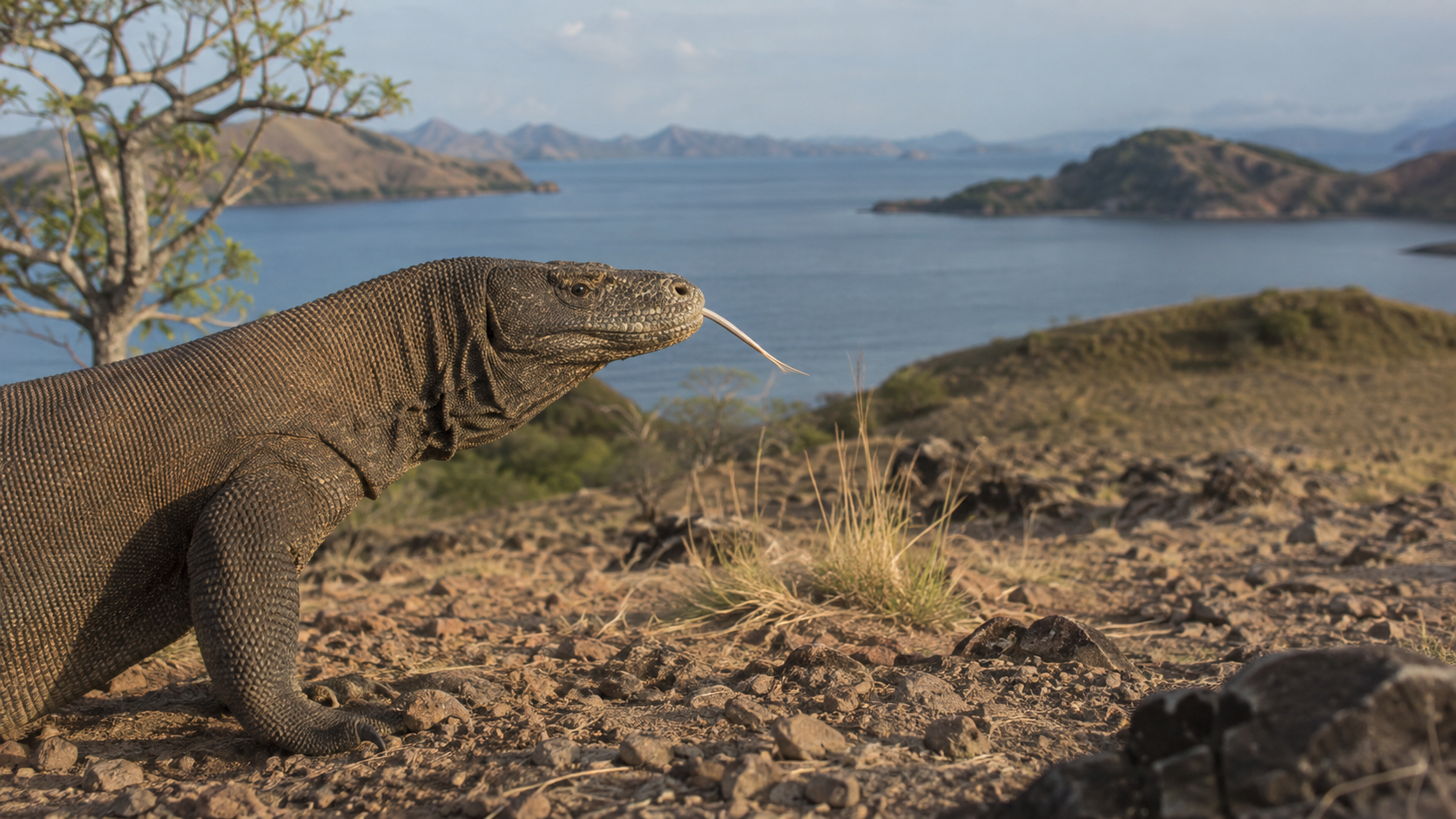
The Komodo dragon (Varanus komodoensis) is a species of lizard found in the Indonesian islands of Komodo, Rinca, Flores, and Gili Motang. It is the largest living lizard species, growing up to 3 meters (10 feet) in length and weighing up to 70 kilograms (154 pounds).
Quick Reference Table
| Scientific Name | Varanus komodoensis |
|---|---|
| Family | Varanidae |
| Conservation Status | Vulnerable |
| Average Length | 2-3 meters (6-10 feet) |
| Average Weight | 40-70 kilograms (88-154 pounds) |
Taxonomy and Identification
The Komodo dragon is a member of the family Varanidae, which includes all monitor lizards. It is the largest species of lizard, and is characterized by its long, flat head, long neck, and long, stout tail. It has a distinctive pattern of scaly skin, with a grayish-brown color on its back and a lighter color on its belly.
Natural Habitat and Distribution
The Komodo dragon is found in the wild only on the Indonesian islands of Komodo, Rinca, Flores, and Gili Motang. It inhabits dry islands with savannas, forests, and hills, and is often found in areas with rocky outcrops and dry riverbeds.
Behaviour
Komodo dragons are carnivores, and feed on a variety of prey including deer, pigs, goats, and water buffalo. They are skilled hunters, and can reach speeds of up to 24 kilometers per hour (15 miles per hour) when chasing prey. They are also known to scavenge for carrion, and will eat almost anything they can find.
Habitat
Komodo dragons live in a variety of habitats, including savannas, forests, and hills. They are often found in areas with rocky outcrops and dry riverbeds, and are well adapted to living in a hot, dry climate. They are excellent climbers, and will often climb trees to bask in the sun or to escape danger.
Diet
Komodo dragons are carnivores, and feed on a variety of prey including deer, pigs, goats, and water buffalo. They are skilled hunters, and can reach speeds of up to 24 kilometers per hour (15 miles per hour) when chasing prey. They are also known to scavenge for carrion, and will eat almost anything they can find.
Responsible Care and Conservation
Komodo dragons are vulnerable to extinction due to habitat loss, hunting, and human persecution. They are protected by law in Indonesia, and conservation efforts are in place to protect their habitat and reduce human-dragon conflict.
Practical Takeaways
Never approach or feed Komodo dragons in the wild, as this can make them associate humans with food and lead to aggressive behavior. Keep a safe distance and respect their space.
Health and Welfare
Komodo dragons are susceptible to several diseases, including respiratory infections and parasites. They are also vulnerable to injury from fighting and hunting.
Conservation Status
The Komodo dragon is listed as vulnerable on the IUCN Red List, due to habitat loss, hunting, and human persecution.
Frequently Asked Questions
What is the average lifespan of a Komodo dragon?
Up to 50 years in the wild, and up to 60 years in captivity.
How big can Komodo dragons get?
Up to 3 meters (10 feet) in length, and up to 70 kilograms (154 pounds) in weight.
Are Komodo dragons venomous?
Yes, Komodo dragons have venomous saliva that can cause septicemia and death in their prey.
Can Komodo dragons be kept as pets?
No, Komodo dragons are wild animals that require specialized care and housing, and are not suitable as pets.
Sources
- National Geographic: Komodo Dragon
- Smithsonian’s National Zoo & Conservation Biology Institute: Komodo Dragon
- IUCN Red List: Varanus komodoensis
Please note: Komodo dragons are wild animals and should not be handled or kept as pets. If you have any concerns about your pet’s health, please consult a licensed veterinarian.
Life Cycle and Development
Komodo dragons have a complex life cycle, with distinct stages of development from hatchling to adulthood. Female Komodo dragons lay their eggs in nests, which they dig themselves, usually in a dry and protected area. The female lays around 15-30 eggs, which incubate for approximately 7-8 months. After hatching, the young Komodo dragons, called hatchlings, are about 40 centimeters (16 inches) long and weigh around 100 grams (3.5 ounces). They are vulnerable to predators and have a high mortality rate during their first few years of life.
As they grow, Komodo dragons go through a series of physical changes, including the development of their distinctive scaly skin pattern and the growth of their long, flat head and tail. They reach sexual maturity at around 5-7 years of age, at which point they can breed and start the cycle again. In the wild, Komodo dragons can live up to 30-50 years, although the average lifespan is around 20-30 years.
Communication and Senses
Komodo dragons have a range of communication methods, including visual, auditory, and chemical signals. They use body language to convey information and express emotions, such as threat displays, courtship behaviors, and submissive postures. They also use vocalizations, including hisses, growls, and grunts, to communicate with other Komodo dragons.
Komodo dragons have a keen sense of smell, which they use to detect prey and predators. They have a highly developed Jacobson’s organ, a specialized olfactory organ found in many reptiles, which allows them to detect pheromones and other chemical signals. They also have excellent eyesight, which helps them to detect movement and changes in their environment.
Seasonal Variation and Ecological Relationships
Komodo dragons are adapted to the dry, tropical climate of their native islands. During the dry season, they are more active and can be found foraging for food and interacting with other Komodo dragons. During the wet season, they are less active and tend to shelter in rocky outcrops and dry riverbeds.
Komodo dragons play a crucial role in their ecosystem, serving as both predators and prey. They prey on a variety of animals, including deer, pigs, and water buffalo, which helps to regulate the populations of these species. They are also preyed upon by other animals, such as eagles and snakes, which helps to regulate their own population.
Research and Conservation Efforts
Komodo dragons have been the subject of extensive research, particularly in the areas of ecology, behavior, and conservation. Scientists have studied their habitat use, diet, and social behavior, as well as their population dynamics and genetic diversity.
Conservation efforts are in place to protect the Komodo dragon and its habitat. The Komodo National Park, which covers the islands of Komodo, Rinca, Flores, and Gili Motang, was established in 1980 to protect the Komodo dragon and its habitat. The park is a UNESCO World Heritage Site and provides a safe haven for the Komodo dragon and other unique species found in the area.
Responsible Enrichment and Captivity
Komodo dragons are sometimes kept in captivity, particularly in zoos and wildlife parks. However, keeping Komodo dragons in captivity is a complex and challenging task, requiring specialized housing, diet, and care. In captivity, Komodo dragons require a large, escape-proof enclosure with a suitable climate and substrate. They also require a varied and nutritious diet, as well as regular veterinary care.
It is essential to ensure that any Komodo dragon kept in captivity is obtained from a reputable source and is not taken from the wild. Many zoos and wildlife parks participate in breeding programs for Komodo dragons, which helps to reduce the demand for wild-caught animals.
Ethical and Legal Considerations
The Komodo dragon is protected by law in Indonesia, and the capture, trade, and export of wild Komodo dragons are strictly regulated. The Convention on International Trade in Endangered Species of Wild Fauna and Flora (CITES) also regulates the international trade of Komodo dragons.
It is essential to consider the welfare and well-being of Komodo dragons in any context, whether in captivity or in the wild. Handling or disturbing Komodo dragons in the wild can be stressful and potentially harmful to the animal, and should be avoided. In captivity, Komodo dragons require specialized care and housing to ensure their physical and psychological well-being.
Reproduction and Growth
Komodo dragons are oviparous, which means they lay eggs. Female Komodo dragons typically lay their eggs in nests made of vegetation and soil, which are often hidden in burrows or under rocks. The female Komodo dragon can lay up to 30 eggs at a time, although the average clutch size is around 15-20 eggs. The eggs incubate for about 7-8 months, and the young Komodo dragons hatch in the spring. The hatchlings are about 40-50 cm (16-20 inches) long and weigh around 100-150 grams (3.5-5.3 ounces). They are able to fend for themselves from a young age and grow rapidly, reaching maturity at around 5-7 years old.
Defence Mechanisms
Komodo dragons have several defence mechanisms to protect themselves from predators. They have sharp claws and powerful tails that they use to defend themselves, and they can also use their sharp teeth to bite. They also have a unique defence mechanism where they can secrete a toxic bacteria from their salivary glands, which can be deadly to their predators. This bacteria is also responsible for the Komodo dragon’s deadly bite, which can kill their prey.
Research and Monitoring
Komodo dragons are an important part of their ecosystem, and researchers are working to study and monitor their populations. Camera traps and radio tracking devices are used to monitor the movement and behavior of Komodo dragons, and researchers are also studying their diet and habitat use. This research is important for conservation efforts and to ensure the long-term survival of the species.
Ecotourism and Education
Komodo dragons are an important part of their ecosystem, and ecotourism can play an important role in their conservation. Responsible tourism can help to support conservation efforts and educate people about the importance of protecting the Komodo dragon and its habitat. Education programs are also important for raising awareness about the Komodo dragon and the importance of conservation.
Threats and Conflicts
Komodo dragons are facing several threats, including habitat loss and fragmentation, human-wildlife conflict, and climate change. They are also vulnerable to disease and poaching, and their populations are declining. Conservation efforts are necessary to protect the Komodo dragon and its habitat, and to address the threats that it is facing.
Conservation Efforts
Several conservation efforts are in place to protect the Komodo dragon and its habitat. The Komodo National Park was established in 1980 to protect the Komodo dragon and its habitat, and it is a UNESCO World Heritage Site. The park is home to over 1,700 Komodo dragons, and it provides a safe habitat for them to live and breed. Conservation efforts are also in place to protect the Komodo dragon from poaching and habitat loss, and to educate people about the importance of conservation.