
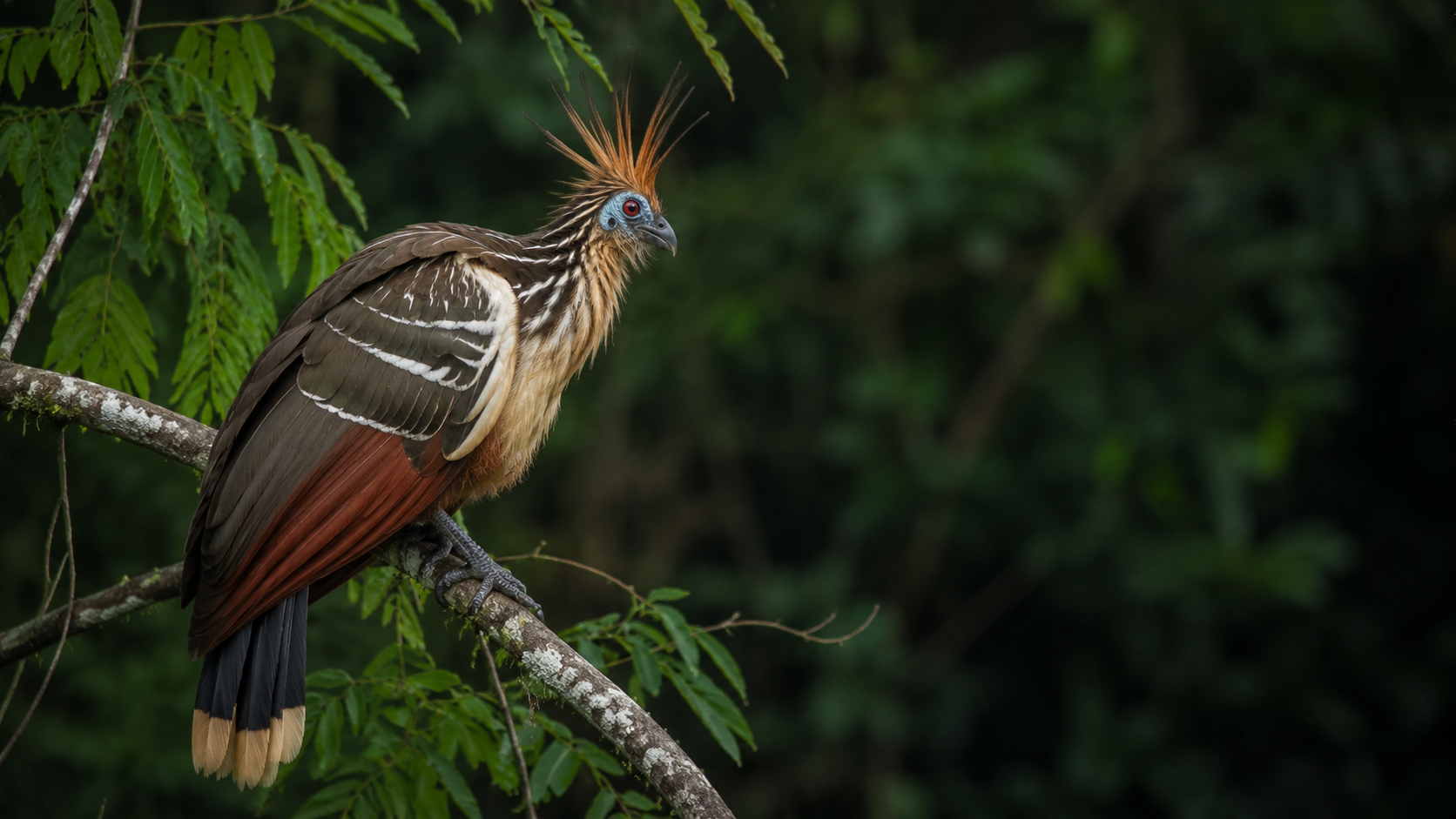
Hoaatzin
The Hoatzin (Opisthocomus hoazin) is a unique and fascinating bird species found in the tropical regions of Central and South America.
Classification and Evolution
The Hoatzin is a member of the family Opisthocomidae and is considered a living fossil, with a distinct evolutionary history that dates back to the time of the dinosaurs.
Physical Characteristics
The Hoatzin has a distinctive appearance, with a brown back, white underside, and a long, broad tail. Its wings are clawed, a trait that is rare among birds, and its feathers have a unique, pungent odor.
Habitat and Distribution
The Hoatzin is found in the tropical regions of Central and South America, including countries such as Mexico, Costa Rica, and Ecuador. It inhabits the dense, humid forests and mangrove swamps of these regions.
Diet and Foraging
The Hoatzin is a herbivore, feeding on leaves, fruits, and flowers. It has a unique digestive system, with a large crop and a specialized gut that allows it to break down and extract nutrients from plant material.
Behavior and Social Structure
The Hoatzin is a social bird that lives in small groups, typically consisting of a breeding pair and their offspring. It is known for its loud, grunting calls and its unique courtship displays.
Conservation Status
The Hoatzin is listed as Least Concern on the IUCN Red List, but its populations are declining due to habitat loss and fragmentation.
| Scientific Name | Opisthocomus hoazin |
|---|---|
| Length | 40-45 cm (16-18 in) |
| Weight | 200-250 g (7-9 oz) |
| Diet | Herbivore |
| Habitat | Tropical forests and mangrove swamps |
Interesting Facts
The Hoatzin has several unique characteristics that set it apart from other birds. Its clawed wings are thought to be an adaptation for climbing and perching in dense vegetation. Its feathers have a pungent odor, which is thought to be a defense mechanism against predators.
Observing Hoatzins in the Wild
Hoatzins can be observed in their natural habitat in the tropical regions of Central and South America. However, it is essential to exercise caution and respect when observing these birds, as they are sensitive to human disturbance.
What is the Hoatzin’s unique characteristic?
The Hoatzin’s unique characteristic is its clawed wings.
What is the Hoatzin’s diet?
The Hoatzin is a herbivore, feeding on leaves, fruits, and flowers.
Where can Hoatzins be found?
Hoatzins can be found in the tropical regions of Central and South America.
Is the Hoatzin endangered?
The Hoatzin is listed as Least Concern on the IUCN Red List, but its populations are declining due to habitat loss and fragmentation.
- International Union for Conservation of Nature (IUCN). (2020). Opisthocomus hoazin.
- BirdLife International. (2020). Hoatzin.
- del Hoyo, J., Elliott, A., & Christie, D. A. (2004). Handbook of the Birds of the World. Volume 6: Mousebirds to Hornbills.
Remember to respect and appreciate these unique birds in their natural habitat, and to support conservation efforts to protect their populations and habitats.
Life Cycle and Development
The Hoatzin’s life cycle is a fascinating process that involves a unique combination of characteristics. The breeding season typically occurs during the dry season, from May to July, although this can vary depending on the location. During this time, males will engage in a series of courtship displays, including loud calls and displays of their brightly colored feathers, to attract females.
Once a pair has formed, they will work together to build a nest, typically in a tree or bush, using twigs, leaves, and other plant material. The female will lay two to four eggs, which will be incubated for approximately 28 days. Both parents will take turns incubating the eggs and caring for the young, which will hatch with their eyes open and covered in a thick layer of down.
The young Hoatzins will remain in the nest for several weeks, during which time they will be fed a diet of regurgitated plant material by their parents. As they grow and develop, they will begin to venture out of the nest, eventually becoming independent and starting their own breeding cycles.
Communication and Senses
Hoatzins are highly vocal birds, using a variety of calls to communicate with each other. They have a distinctive, grunting call that is often used for contact and alarm, as well as a series of higher-pitched calls that are used for courtship and territorial displays.
In addition to their vocalizations, Hoatzins also use visual displays to communicate. They have a range of brightly colored feathers, including their distinctive crest and wing feathers, which they will display during courtship and territorial displays.
Hoatzins also have a highly developed sense of smell, which they use to locate food and detect predators. Their unique, pungent odor is thought to be an adaptation to deter predators, and is often used in conjunction with their vocalizations to alert other Hoatzins to potential threats.
Seasonal Variation
Hoatzins are found in tropical regions with high levels of rainfall, and as such, their behavior and ecology are closely tied to the seasonal patterns of their environment. During the dry season, Hoatzins will often congregate in larger groups, taking advantage of the abundant food sources that are available.
In contrast, during the wet season, Hoatzins will often disperse, seeking out smaller, more secluded areas to forage and breed. This seasonal variation in behavior is thought to be an adaptation to the changing availability of food and shelter, and allows Hoatzins to thrive in a variety of environments.
Ecological Relationships
Hoatzins play a unique role in their ecosystems, serving as both predators and prey for a variety of other species. They are an important food source for a range of predators, including snakes, monkeys, and birds of prey.
In addition to their role as prey, Hoatzins also play a key role in seed dispersal and forest regeneration. Their unique digestive system allows them to break down and extract nutrients from plant material, and they are able to deposit seeds in new areas, often in nutrient-rich feces.
This process is thought to be an important mechanism for the spread of certain plant species, and highlights the complex and interconnected nature of tropical ecosystems.
Research and Conservation Efforts
Despite their unique characteristics and fascinating ecology, Hoatzins remain a relatively understudied species. However, in recent years, there has been an increasing amount of research focused on their behavior, ecology, and conservation.
One of the main threats facing Hoatzin populations is habitat loss and fragmentation, as their tropical habitats are cleared for agriculture and urban development. Conservation efforts are underway to protect and restore these habitats, and to promote sustainable land-use practices.
In addition to habitat conservation, researchers are also working to better understand the Hoatzin’s unique digestive system, and to develop strategies for responsible enrichment and management of captive populations.
Responsible Enrichment and Management
Hoatzins are popular birds in captivity, and are often kept in zoos and wildlife parks. However, their unique characteristics and specialized needs require careful consideration and management.
Responsible enrichment and management of captive Hoatzin populations involves providing a varied and nutritious diet, as well as a stimulating and naturalistic environment. This can include the provision of live plants, branches, and other natural materials, as well as opportunities for social interaction and exercise.
In addition to these considerations, it is also important to ensure that captive Hoatzin populations are managed in a way that is consistent with their ecological and evolutionary history. This can involve the use of naturalistic enclosures, and the promotion of natural behaviors and social interactions.
Ethical and Legal Considerations
Hoatzins are protected by a range of laws and regulations, including the Convention on International Trade in Endangered Species of Wild Fauna and Flora (CITES). These laws prohibit the capture and trade of Hoatzins, and provide protections for their habitats and ecosystems.
In addition to these legal considerations, there are also a range of ethical considerations that must be taken into account when interacting with Hoatzins. These include the need to prioritize their welfare and well-being, and to ensure that any interactions or management practices are carried out in a responsible and sustainable way.
Adaptation to Environment
The Hoatzin’s unique characteristics and behaviors have allowed it to thrive in its tropical environment. One of the most notable adaptations is its ability to survive on a diet of low-nutrient leaves. The bird’s specialized gut and large crop allow it to break down and extract nutrients from plant material, making it one of the few birds that can survive on a diet of leaves. This adaptation is crucial in its environment, where leaves are abundant but other food sources may be scarce.
In addition to its dietary adaptations, the Hoatzin has also developed unique physical characteristics that allow it to navigate its environment. Its clawed wings, for example, allow it to climb through the dense foliage of its forest habitat, while its broad tail provides balance and support as it moves through the trees. The Hoatzin’s strong legs and sharp claws also enable it to perch on thin branches and grasp onto vines, allowing it to forage for food in the forest canopy.
Role in Ecosystem
The Hoatzin plays a vital role in its ecosystem, serving as both a seed disperser and a nutrient vector. As the bird forages for fruit and leaves, it ingests seeds that are then deposited in new locations, often in nutrient-rich droppings. This process allows the Hoatzin to contribute to the spread of plant species and the maintenance of forest diversity.
In addition to its role in seed dispersal, the Hoatzin also serves as a nutrient vector, transporting nutrients from one location to another through its droppings. This process is particularly important in the Hoatzin’s forest habitat, where nutrient availability can be limited. By depositing nutrient-rich droppings in new locations, the Hoatzin helps to maintain soil fertility and support the growth of new plant life.
Cultural Significance
The Hoatzin has significant cultural and spiritual importance in many of the communities where it is found. In some indigenous cultures, the Hoatzin is considered a sacred animal, associated with fertility and abundance. In other cultures, the bird is seen as a symbol of good luck and prosperity.
In addition to its cultural significance, the Hoatzin has also been the subject of scientific fascination. Its unique characteristics and behaviors have made it a popular subject for study, and it has been the focus of numerous research projects and conservation efforts. By studying the Hoatzin and its habits, scientists can gain a deeper understanding of the complex relationships between species and their environments, and develop new strategies for conservation and management.
Threats and Challenges
Despite its cultural and scientific significance, the Hoatzin faces numerous threats and challenges in the wild. Habitat loss and fragmentation, driven by deforestation and agricultural development, have reduced the bird’s habitat and isolated its populations. Climate change also poses a significant threat, as changing temperature and precipitation patterns alter the availability of food and habitat for the Hoatzin.
In addition to these environmental threats, the Hoatzin is also vulnerable to hunting and persecution. In some areas, the bird is seen as a pest, and is hunted for its feathers and meat. In other areas, the Hoatzin is persecuted as a result of its unique odor, which is often associated with death and disease.
Conservation and Management
Efforts are underway to conserve and manage the Hoatzin population. Protected areas, such as national parks and wildlife reserves, provide a safe habitat for the bird and help to maintain its population. Research and monitoring programs are also in place, tracking the bird’s population and habitat use, and informing conservation and management decisions.
In addition to these conservation efforts, education and outreach programs are also important for promoting the Hoatzin’s conservation. By raising awareness about the bird’s unique characteristics and cultural significance, conservationists can build support for its protection and promote sustainable land-use practices that minimize habitat loss and fragmentation.


