Natural History
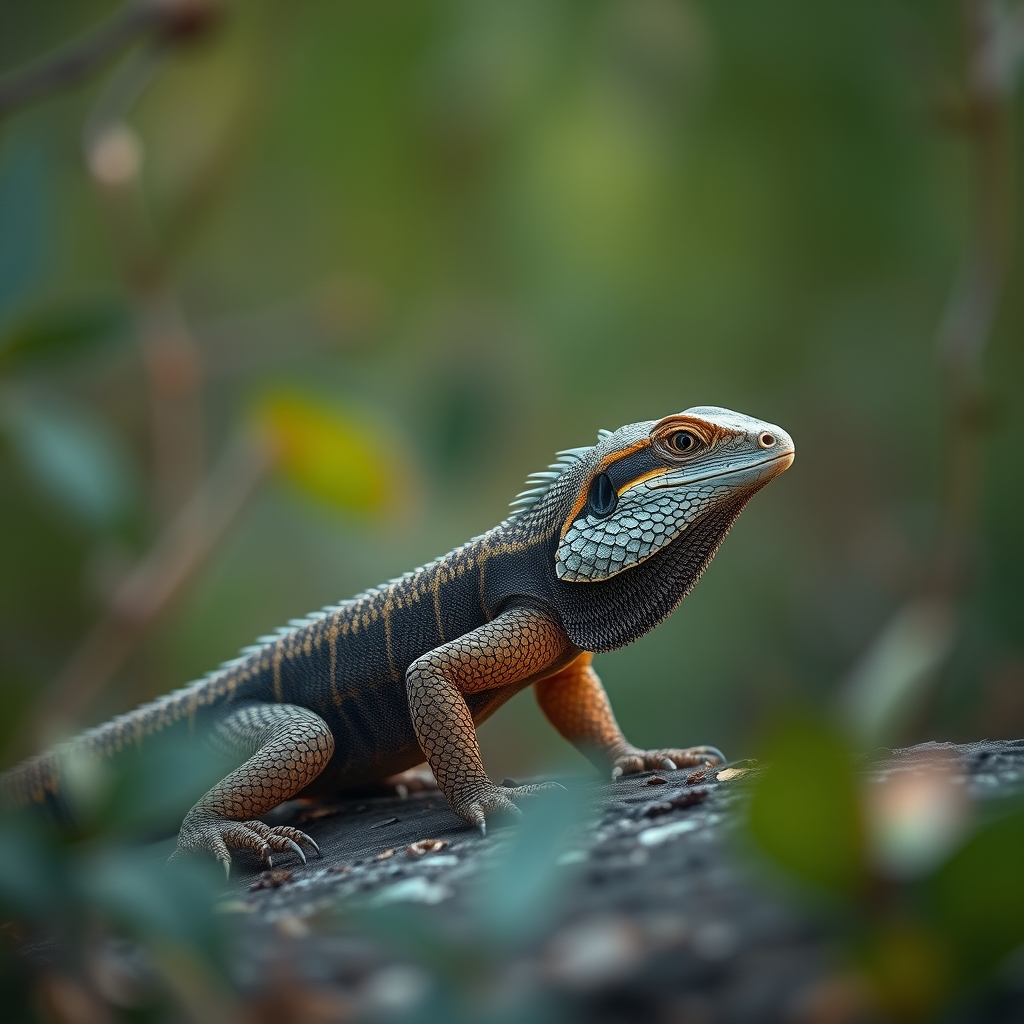
The Frilled-necked Lizard (Chlamydosaurus kingii) is a large arboreal lizard native to the tropical and subtropical regions of Australia and New Guinea. It is a member of the family Agamidae and is also known as the Frill-necked Lizard or Frilly.
Frilled-necked Lizards are characterized by their distinctive frill, which is a ruff of skin around their neck that can be raised and lowered at will. This frill is used for display purposes, such as during courtship or when threatened. They have a long, slender body, typically brown or gray in color, with a white or yellowish belly.
Habitat and Distribution
Frilled-necked Lizards are found in the tropical and subtropical regions of northern Australia, including the Northern Territory, Western Australia, and Queensland. They are also found in southern New Guinea. They inhabit forests, woodlands, and savannas, and are often seen basking in trees or on rocks.
Diet and Foraging
Frilled-necked Lizards are omnivores, feeding on a variety of insects, fruits, and leaves. They forage for food on the ground and in trees, using their sharp eyesight and agile limbs to catch prey.
Behavior and Social Structure
Frilled-necked Lizards are generally solitary animals, only coming together during the breeding season. Males engage in a complex courtship display, which involves raising their frill and performing a series of head bobs and push-ups. Females lay clutches of up to 20 eggs, which incubate for approximately 60 days.
Conservation Status
Frilled-necked Lizards are listed as Least Concern on the IUCN Red List, although their populations are declining in some areas due to habitat loss and fragmentation.
| Scientific Name | Chlamydosaurus kingii |
|---|---|
| Family | Agamidae |
| Genus | Chlamydosaurus |
| Species | C. kingii |
| Conservation Status | Least Concern |
Public Safety and Handling
Frilled-necked Lizards are wild animals and should not be handled or kept as pets. They have sharp claws and can inflict serious injury if threatened or scared. It is also important to note that they are protected by laws in some areas, and harming or removing them from the wild can result in serious penalties.
Responsible Observation
If you are interested in observing Frilled-necked Lizards in their natural habitat, it is essential to do so responsibly and with caution. Keep a safe distance, avoid disturbing their habitat, and never attempt to touch or handle them.
What is the average lifespan of a Frilled-necked Lizard?
Up to 20 years in the wild, although the average lifespan is around 10-15 years.
How big can Frilled-necked Lizards grow?
Up to 90 cm (35 in) in length, including their tail.
Are Frilled-necked Lizards venomous?
No, they are not venomous.
Can I keep a Frilled-necked Lizard as a pet?
No, Frilled-necked Lizards are wild animals and should not be kept as pets.
- Australian Museum. (n.d.). Frilled-necked Lizard. Retrieved from https://australian.museum/learn/animals/reptiles/frilled-necked-lizard
- IUCN Red List. (2020). Chlamydosaurus kingii. Retrieved from https://www.iucnredlist.org/species/170384/115469221
- Queensland Government. (n.d.). Frilled-necked Lizard. Retrieved from https://www.qld.gov.au/environment/wildlife/caring-for-wildlife/frilled-necked-lizard
Important Notice: If you suspect that your pet has ingested or come into contact with a wild animal, such as a Frilled-necked Lizard, please seek veterinary advice immediately. Wild animals can carry diseases and parasites that can be transmitted to domestic animals and humans.
Life Cycle and Development
Frilled-necked Lizards have a fascinating life cycle, with distinct stages of development that are crucial for their survival. The breeding season typically occurs during the wet season, when males engage in intense courtship displays to attract females. During this time, males will raise their frills, bob their heads, and perform a series of push-ups to showcase their strength and dominance. Females, on the other hand, will signal their receptiveness to mating by displaying a bright yellow coloration on their throat and chest.
After mating, females will lay a clutch of 8-23 eggs in a nesting site, usually a burrow or a hidden crevice. The eggs incubate for approximately 70-80 days, during which time the female will guard the nest site and maintain a stable temperature by basking in the sun. Once the eggs hatch, the young lizards will emerge, measuring around 10-15 cm in length. The hatchlings will receive no parental care and will immediately start foraging for food and shelter.
As the young lizards grow, they will undergo a series of molts, shedding their skin to accommodate their increasing size. During this time, they will also develop their distinctive frill, which will become more prominent as they mature. Juvenile Frilled-necked Lizards will reach sexual maturity at around 2-3 years of age, at which point they will begin to participate in the breeding cycle.
Communication and Senses
Frilled-necked Lizards rely on a range of communication strategies to convey information and maintain social bonds. Visual displays, such as the raising of the frill, play a crucial role in signaling aggression, courtship, or warning calls. They also use body language, such as posturing and head-bobbing, to convey dominance or submission.
In addition to visual cues, Frilled-necked Lizards possess a keen sense of smell, which they use to detect food, predators, and potential mates. They have a highly developed olfactory system, which allows them to detect subtle changes in their environment. Their sense of hearing is also acute, and they can detect a wide range of frequencies, including low-frequency vibrations that may signal the presence of predators.
Frilled-necked Lizards also possess excellent eyesight, with a wide field of vision and the ability to detect movement quickly. Their eyes are positioned on the sides of their head, allowing them to scan their surroundings for potential threats or prey. This combination of sensory abilities enables Frilled-necked Lizards to navigate their environment effectively and respond to potential threats.
Seasonal Variation and Ecological Relationships
Frilled-necked Lizards are adapted to the tropical and subtropical regions of Australia and New Guinea, where they experience a range of seasonal variations. During the wet season, they are more active, foraging for food and engaging in courtship displays. The wet season also provides an abundance of food, including insects and fruits, which allows them to build up their energy reserves.
In contrast, the dry season brings a reduction in food availability, and Frilled-necked Lizards must rely on their stored energy reserves to survive. During this time, they will often estivate, hiding in burrows or under rocks to conserve energy and water. This adaptation allows them to survive the harsh conditions of the dry season and emerge when food becomes more abundant.
Frilled-necked Lizards play a crucial role in their ecosystems, serving as both predators and prey. They feed on a range of insects, including beetles and grasshoppers, which helps to regulate their populations. In turn, they are preyed upon by larger predators, such as snakes, birds, and mammals. This complex web of relationships highlights the importance of Frilled-necked Lizards in maintaining the balance of their ecosystems.
Research and Conservation Efforts
Frilled-necked Lizards have been the subject of various research studies, which have shed light on their behavior, ecology, and conservation status. Scientists have used a range of techniques, including radio tracking and camera traps, to monitor their movements and habitat use. These studies have provided valuable insights into their behavior and have informed conservation efforts.
Conservation efforts for Frilled-necked Lizards are focused on protecting their habitats and reducing the impact of human activities, such as deforestation and mining. National parks and protected areas have been established to provide a safe haven for these lizards, and education programs have been implemented to raise awareness about their importance and the threats they face.
In addition, researchers are working to develop effective conservation strategies, such as habitat restoration and species reintroduction programs. These efforts aim to restore degraded habitats and reestablish populations in areas where they have become extinct. By working together, scientists, conservationists, and local communities can help to ensure the long-term survival of Frilled-necked Lizards.
Responsible Enrichment and Ethical Considerations
Frilled-necked Lizards are popular among reptile enthusiasts, and many people keep them as pets. However, it is essential to consider the welfare of these animals and provide them with suitable care and housing. Responsible enrichment involves providing a stimulating environment that meets their physical and behavioral needs.
This includes providing a large enclosure with adequate ventilation, temperature control, and UVB lighting. A varied diet that includes a range of insects and fruits is also essential, as is access to fresh water and a shallow water dish for soaking. Handling should be minimal, as Frilled-necked Lizards can be stressed by excessive handling.
It is also essential to consider the ethical implications of keeping Frilled-necked Lizards as pets. Many wild-caught individuals are taken from their natural habitats, which can harm local populations and ecosystems. In addition, the pet trade can drive demand for wild-caught animals, perpetuating the cycle of exploitation. By choosing captive-bred individuals and supporting responsible breeding programs, enthusiasts can help to reduce the demand for wild-caught animals and promote the conservation of Frilled-necked Lizards.
Adaptation to Environmental Pressures
Frilled-necked Lizards have evolved several adaptations to cope with the environmental pressures of their tropical and subtropical habitats. One of the most notable adaptations is their ability to regulate their body temperature. They are ectothermic, meaning that they rely on external sources of heat to regulate their body temperature, and they often bask in the sun to warm up. However, they also have a range of behaviors to avoid overheating, such as seeking shade, panting, and even using their frill to radiate excess heat.
Another adaptation of Frilled-necked Lizards is their ability to survive in areas with limited water availability. They are able to conserve water by producing highly concentrated urine and dry feces, and they can also obtain moisture from their food. In addition, they have a range of behaviors to collect and conserve water, such as licking dew from leaves and storing water in their bodies.
Frilled-necked Lizards also have adaptations to deal with predators. Their frill is an important defense mechanism, as it makes them appear larger and more intimidating to potential predators. They also have a range of other defense strategies, such as freezing in place, using their sharp claws to deter predators, and even playing dead.
Ecological Role
Frilled-necked Lizards play an important ecological role in their habitats. As both predators and prey, they are an integral part of the food chain. They feed on a range of invertebrates, including insects and spiders, which helps to regulate their populations and maintain the balance of the ecosystem. They are also an important food source for other animals, such as birds, snakes, and other lizards.
Frilled-necked Lizards also play a role in seed dispersal and forest regeneration. They eat fruit and then deposit the seeds in new locations, often in nutrient-rich areas, which helps to promote the growth of new plants. This process is particularly important in tropical and subtropical forests, where seed dispersal is a key mechanism for maintaining the diversity of plant species.
Cultural Significance
Frilled-necked Lizards have significant cultural and spiritual importance in the indigenous cultures of Australia and New Guinea. In some Aboriginal cultures, the Frilled-necked Lizard is considered a symbol of strength and resilience, and is often depicted in traditional art and storytelling. In other cultures, the lizard is associated with fertility and abundance, and is celebrated in traditional ceremonies and rituals.
In addition to their cultural significance, Frilled-necked Lizards are also an important part of the tourism industry in northern Australia and New Guinea. They are a popular attraction in national parks and wildlife sanctuaries, and are often featured in wildlife documentaries and photography.
Threats and Challenges
Despite their cultural and ecological significance, Frilled-necked Lizards are facing a range of threats and challenges. Habitat destruction and fragmentation, primarily due to deforestation and urbanization, are major concerns, as they reduce the availability of food, shelter, and breeding habitats for the lizards. Climate change is also a significant threat, as it alters the temperature and rainfall patterns that the lizards rely on for survival.
In addition, Frilled-necked Lizards are often persecuted by humans, who view them as pests or threats to agriculture. They are also collected for the pet trade, which can lead to population declines and even local extinctions.